WHEN THE SHELVES START EMPTYING
Food failure starts long before nobody has anything to eat.
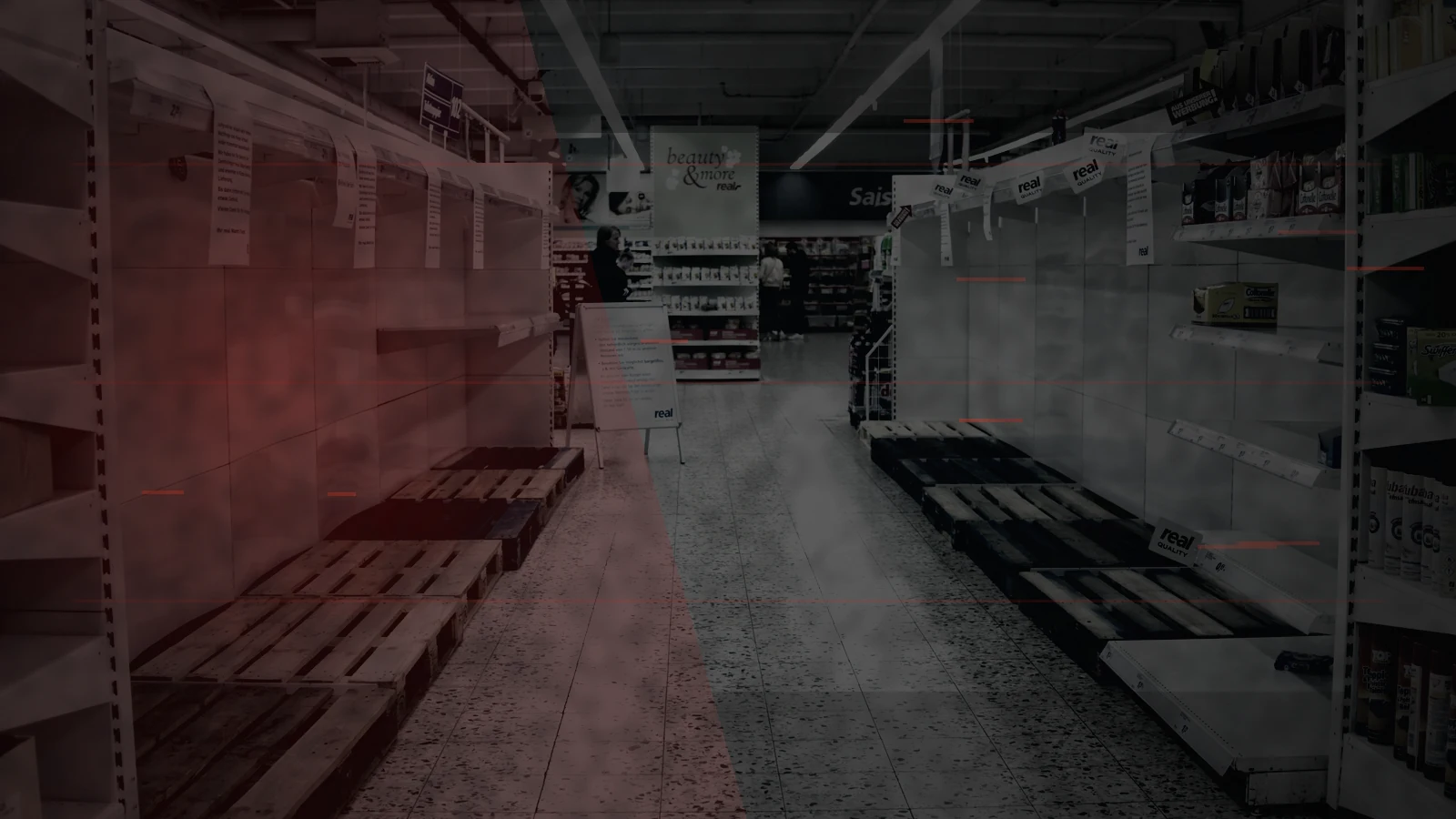
A broken supply chain hits deliveries, refrigeration, payments, fuel, staffing and household routines at the same time. Build a food system that can survive the first 72 hours, then stretch to 30 and 90 days without relying on panic buying or fantasy rations.
CORE FOOD SURVIVAL GUIDES
Build meals before the system gets noisy
These six guides cover immediate shortage response, a 72-hour reserve, 30- and 90-day storage, no-cook meals and the order to use food during a power cut.
Food Shortage Survival Guide
Turn what you already own into a controlled household food plan.
Open guide → FIRST 72 HOURS72-Hour Emergency Food List
Build three days of familiar meals that still work without a fresh shop.
Open list → 30-DAY RESERVE30-Day Emergency Food Supply
Scale a tested weekly menu into a realistic month of food.
Open plan → LONG DURATION90-Day Food Storage Plan
Build a three-month reserve that can actually be rotated and cooked.
Open plan → NO POWER / NO GASNo-Cook Emergency Foods
Keep complete meals available when safe cooking disappears.
Open guide → POWER OUTAGEWhat To Eat First in a Power Cut
Protect the cold chain and use food in the safest order.
Open guide →THE SUPPLY FAILURE CHAIN
The supermarket is only the visible end of the system.
Fuel, drivers and route access determine whether food reaches regional depots and shops.
Warehouses, refrigeration, tills and cold storage all depend on electricity.
Card-network or banking failure can stop purchases even while stock remains.
Fear can empty visible shelves faster than the underlying supply system fails.
FREE FIELD MANUAL
If deliveries stopped tonight, could your household eat for 72 hours?
Build the wider plan around food, water, power, communications, medication and family contact before disruption forces the decisions.
DEEPER FOOD & SUPPLY GUIDES
Cold chains, supermarket shortages and total supply-chain failure
Go deeper into freezer safety, supermarket planning, household endurance, emergency meal planning, storage mistakes and the full supply-chain-collapse scenario.
Freezer Food Power Cut Safety
Decide what remains safe as frozen food begins to thaw.
Open guide → SHORTAGE RESPONSESupermarket Shortage Plan
Prepare for gaps without contributing to panic demand.
Open guide → HOUSEHOLD ENDURANCEHow Long Does Your Food Supply Last?
Turn cupboards and calories into a realistic number of days.
Open guide → MENU SYSTEMEmergency Meal Planner
Build repeatable meals around food, water and cooking constraints.
Open guide → FAILURE MODESFood Storage Mistakes
Avoid pests, wasted stock, bad rotation and unrealistic menus.
Open guide → CATASTROPHIC SCENARIOSupply Chain Collapse Guide
Stress-test food access when transport, power, payments and distribution fail together.
Enter scenario →Connect this part of the plan
FOOD RESILIENCE
Build a food reserve that works when normal shopping does not
A useful household reserve is built around food people already eat, can store safely and can prepare with limited power or fuel. Ready-to-eat options cover the first hours, while shelf-stable staples extend the plan without relying on a freezer or daily deliveries.
Think about the dependencies behind the food as well as the food itself. Some meals require extra water, tins need a manual opener and frozen food becomes time-sensitive during a long outage. A varied reserve is more flexible than a large supply of one type of product.
Rotate supplies through normal meals
Check dates and packaging periodically and use older stock before replacing it. Rotation reduces waste and means the household is familiar with what has been stored. The guides in this section cover refrigeration loss, cooking without mains power, supermarket disruption and practical rationing so the reserve can be matched to the scenario.
Use the reserve in layers
The first day of an outage is different from the fifth. Keep some food that needs no cooking for the immediate period, then use refrigerated and frozen food while it remains safe, followed by shelf-stable meals for a longer disruption. That order reduces waste and avoids spending fuel or water unnecessarily at the start.
Households with infants, allergies, medical diets or pets need those requirements included from the beginning. A reserve is only useful if the people relying on it can actually eat it. Keep a simple written inventory so gaps are visible before a disruption and so rotation does not depend on memory.
Keep the reserve easy to count
A simple written inventory makes shortages visible before they become urgent. Group food by meal type or use-by period, note what requires cooking, and keep the most frequently rotated items where they are easy to reach. This makes ordinary rotation simpler and reduces the chance of discovering expired or unusable supplies during an outage.
Review the reserve after changes in household size, dietary needs or storage space so the plan remains realistic.
MORE GUIDES
More evidence-led guides
Food Shortage Preparation List: What a UK Household Actually Needs
Food shortage preparation list: practical shelf-stable foods, rotation, dietary needs, cooking constraints and how to build resilience without panic buying.
Open guide →GUIDEShould We Prepare for a Food Shortage? A Sensible UK Answer
Should we prepare for a food shortage? How ordinary pantry resilience helps with storms, power cuts and supply disruption without assuming a national crisis.
Open guide →GUIDEHow to Prepare for a Food Shortage Without Panic Buying
How to prepare for a food shortage: pantry planning, rotation, no-cook foods, dietary needs, water, power cuts and a calm UK household approach.
Open guide →GUIDEEmergency Food Storage UK: A Practical Pantry Plan for Real Homes
Emergency food storage UK: how much to keep, where to store it, rotation, food safety, small-space options and what belongs in a resilient household pantry.
Open guide →GUIDEEmergency Food Storage Calculator: How to Estimate Days, Meals and Household Needs
Emergency food storage calculator guide: estimate household meals, calories, water dependence, dietary needs and storage space without buying arbitrary survival kits.
Open guide →GUIDEAI Food Supply Chain: Where Automation Helps and Where New Risks Appear
AI food supply chain explained: forecasting, logistics, quality control, agriculture, cyber risk and why food systems remain physical and distributed.
Open guide →GUIDEAI Food Supply Chain Risks: Cyber, Forecasting and Single-Point-of-Failure Problems
AI food supply chain risks: bad forecasts, cyberattacks, automation dependence, inventory errors and how resilient food networks limit cascading failures.
Open guide →MORE GUIDES
More evidence-led guides
Emergency Food Storage: A Practical Pantry That Actually Gets Used
Emergency food storage guide: rotation, shelf-stable foods, no-cook options, dietary needs and how to build a useful reserve without waste.
Open guide →GUIDEEmergency Food Storage Containers: What Should Be Sealed, Labelled or Left in Original Packaging?
Emergency food storage containers: pests, moisture, labelling, original packaging and when extra containers actually improve shelf life.
Open guide →GUIDEEmergency Food Storage List: Build It by Meals, Not by Random Tins
Emergency food storage list: breakfast, lunch, dinner, snacks, dietary needs, water and no-cook choices for a practical household reserve.
Open guide →GUIDEEmergency Food Storage Ideas for Small UK Kitchens and Normal Budgets
Emergency food storage ideas: cupboard rotation, under-bed bins, no-cook meals, compact foods and ways to build resilience in limited space.
Open guide →GUIDEEmergency Food Storage Buckets: Useful Tool or Unnecessary Expense?
Emergency food storage buckets: food-grade materials, dry staples, moisture, liners, access and when buckets make sense for household preparedness.
Open guide →GUIDEEmergency Food Storage Kits: What to Check Before Buying One
Emergency food storage kits: meal count, calories, water needs, allergens, shelf life and how to compare kits with an ordinary rotating pantry.
Open guide →GUIDEEmergency Food Storage Supplies: The Useful Basics Beyond the Food Itself
Emergency food storage supplies: can opener, labels, containers, cooking backup, hygiene and the simple extras that make a pantry usable during disruption.
Open guide →GUIDEFood Shortage UK: How to Separate Real Supply Problems From Panic Headlines
Food shortage UK explained: supermarket gaps, logistics, weather, imports, local disruption and a sensible household response without panic buying.
Open guide →GUIDEFood Shortage UK 2026: What Is Actually Worth Monitoring?
Food shortage UK 2026: how to evaluate current shortage claims using supply, weather, logistics and official evidence without turning uncertainty into panic.
Open guide →GUIDEWhat Foods to Buy for Emergency Preparedness: A Practical UK List
What foods to buy for emergency preparedness: shelf-stable meals, proteins, snacks, dietary needs, low-cook options and how to rotate everything normally.
Open guide →MORE GUIDES
More evidence-led guides
Emergency Pantry Supplies: The Non-Food Items That Make Stored Food Usable
Emergency pantry supplies: can opener, labels, storage containers, hygiene, simple cooking and the practical extras that support emergency food.
Open guide →GUIDEEmergency Pantry Items: The Core Foods and Supplies Worth Keeping
Emergency pantry items: shelf-stable meals, proteins, carbohydrates, snacks, drinks and household-specific additions for a rotating reserve.
Open guide →GUIDEEmergency Pantry List: A Simple UK Checklist by Meal
Emergency pantry list: breakfast, lunch, dinner, snacks, drinks, dietary needs and a simple way to organise a rotating household reserve.
Open guide →MORE GUIDES
More evidence-led guides
No-Cook Emergency Meals: Food Options When the Power Is Off
No-Cook Emergency Meals — Food Options When the Power Is Off. Evidence-led guidance, practical limits and the steps that matter most.
Open guide →GUIDEEmergency Food for a Power Cut: What to Eat First and What to Store
Emergency Food for a Power Cut — What to Eat First and What to Store. Evidence-led guidance, practical limits and the steps that matter most.
Open guide →MORE GUIDES
More evidence-led guides
Emergency Food Storage for a Small Flat: Compact Pantry Ideas
Emergency Food Storage for a Small Flat — Compact Pantry Ideas. Evidence-led guidance, practical limits and the steps that matter most.
Open guide →GUIDEEmergency Food on a Budget: Build a Reserve Through Normal Shopping
Emergency Food on a Budget — Build a Reserve Through Normal Shopping. Evidence-led guidance, practical limits and the steps that matter most.
Open guide →GUIDEEmergency Food Without a Fridge: Shelf-Stable Meal Planning
Emergency Food Without a Fridge — Shelf-Stable Meal Planning. Evidence-led guidance, practical limits and the steps that matter most.
Open guide →GUIDEEmergency Food With Limited Water: Choose Meals That Do Not Drain the Reserve
Emergency Food With Limited Water — Choose Meals That Do Not Drain the Reserve. Evidence-led guidance, practical limits and the steps that matter most.
Open guide →MORE GUIDES
More evidence-led guides
Emergency Food Supply UK: Build a Reserve Through Normal Shopping
Emergency Food Supply UK — Build a Reserve Through Normal Shopping. Evidence-led guidance, practical limits and the steps that matter most.
Open guide →GUIDEEmergency Food Rations UK: When Compact Rations Make Sense and When They Do Not
Emergency Food Rations UK — When Compact Rations Make Sense and When They Do Not. Evidence-led guidance, practical limits and the steps that matter most.
Open guide →GUIDEEmergency Food Kit UK: What to Include for Short Household Disruption
Emergency Food Kit UK — What to Include for Short Household Disruption. Evidence-led guidance, practical limits and the steps that matter most.
Open guide →GUIDEEmergency Food List UK: A Practical Cupboard Checklist
Emergency Food List UK — A Practical Cupboard Checklist. Evidence-led guidance, practical limits and the steps that matter most.
Open guide →GUIDESurvival Food UK: What Is Actually Useful in an Ordinary Home
Survival Food UK — What Is Actually Useful in an Ordinary Home. Evidence-led guidance, practical limits and the steps that matter most.
Open guide →MORE GUIDES
More evidence-led guides
Emergency Food Supply List UK: Build It Around Real Meals
Emergency Food Supply List UK — Build It Around Real Meals. Evidence-led guidance, practical limits and the steps that matter most.
Open guide →GUIDEWhat to Store for Emergency Food: A Practical Decision Framework
What to Store for Emergency Food — A Practical Decision Framework. Evidence-led guidance, practical limits and the steps that matter most.
Open guide →GUIDEFood to Store for an Emergency UK: Ordinary Pantry Options That Work
Food to Store for an Emergency UK — Ordinary Pantry Options That Work. Evidence-led guidance, practical limits and the steps that matter most.
Open guide →GUIDEEmergency Food With No Power: Meals That Do Not Depend on the Cooker
Emergency Food With No Power — Meals That Do Not Depend on the Cooker. Evidence-led guidance, practical limits and the steps that matter most.
Open guide →GUIDEEmergency Pantry List UK: A Simple Cupboard Audit
Emergency Pantry List UK — A Simple Cupboard Audit. Evidence-led guidance, practical limits and the steps that matter most.
Open guide →FREE 25-PAGE FIELD MANUAL
Your first 72 hours should not live in your head.
Turn the advice into a written household plan: water, power, food, communications, health continuity, information verification and movement decisions.