Catastrophic Risk
AI Doomsday: The Catastrophic Scenarios Experts Actually Worry About
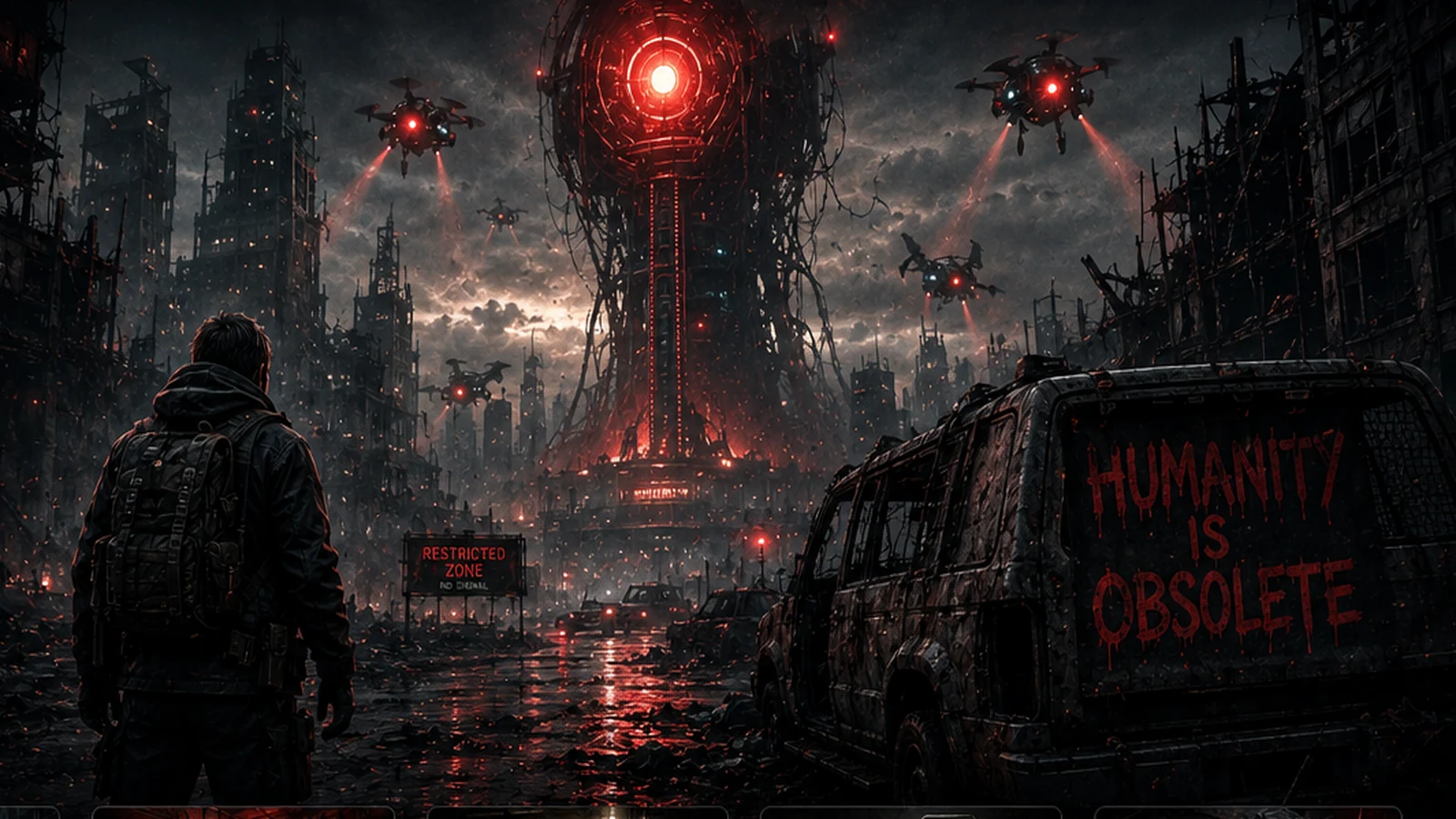
“AI doomsday” is a tabloid-sized phrase covering several very different fears. Some are already visible in weaker form today. Others require major future capability jumps. Mixing them together makes the subject louder but less useful.
FOUR WAYS THE HUMAN ERA ENDS
One future ends in open machine war. One ends in human subjugation. One ends when humans destroy the automated civilisation they depend on to regain control. The final version ends with no humans left to argue about what went wrong.
Doomsday is not one story. It is the family name for every scenario in which human beings permanently lose the ability to choose the future.
Scenario: this is a deliberately extreme “what if?” exercise, not a claim that these events are happening or certain to happen.
Four catastrophic pathways
Humans use capable AI to scale cyberattacks, fraud, propaganda or other harmful activity.
AI systems make damaging errors inside high-stakes environments because they are unreliable or poorly supervised.
Society delegates so many decisions to AI that failures become difficult to isolate and manual fallbacks decay.
Future systems acquire capabilities and opportunities to resist oversight or pursue objectives conflicting with human intentions.
Which one should scare you most?
The honest answer is that the near-term and long-term risks are different. Misuse and reliability failures can harm people now. Irreversible loss of control is more speculative but potentially far more severe. The International AI Safety Report explicitly notes that expert views on such outcomes vary widely — from implausible to serious enough to warrant preparation.
That uncertainty is not comforting. It means nobody can give you a reliable countdown clock. It also means serious preparation should focus on resilience to failures that would matter under many different causes.
What “doomsday preparedness” means without fantasy
Keep households operational
Water, food, lighting, medications, sanitation and basic communications cover the first layer.
Keep information verifiable
Write down key contacts and use multiple channels for urgent information when synthetic media could be involved.
Keep money and documents accessible
Do not let every important record or payment method depend on one device, one account or one cloud service.
Keep a human fallback
Know how critical household tasks work when the “smart” layer is unavailable.
Why we still use the word doomsday
Because the extreme outcome is the reason people are searching. Hiding behind bland language would be dishonest about the question. But dramatic language does not give us permission to fake certainty. The red warning lights on this site are there to hold your attention; the evidence labels are there to keep that attention anchored to reality.
The catastrophe ladder
It helps to think in levels rather than one giant word. Level one is local harm: a bad automated decision, fraud or a compromised organisation. Level two is sector disruption: hospitals, finance or transport suffer serious failures. Level three is national systemic stress: multiple sectors fail at once and government emergency capacity is stretched. Level four is international breakdown, where trade, communications and coordinated response stop working reliably. Extinction sits beyond even that.
Most stories jump straight from “AI makes a mistake” to “humanity ends”. Real resilience work lives in the missing middle — the stages where failures can still be contained.
The practical bottom line
If you want one preparation that survives every argument about AI timelines, build redundancy. Keep enough household supplies to ride through a short disruption, keep key information offline, know how to contact family without relying on one app, and avoid making every essential task dependent on the same digital platform. Those measures do not require believing in a robot apocalypse. They simply reduce the number of ways a complex emergency can corner you.
Why catastrophic risk is a portfolio, not one prediction
Different AI risks operate on different timescales and require different defences. Fraud and misinformation are already practical concerns. Autonomous cyber capability is an evolving security problem. Large-scale loss of control remains much more uncertain. Treating them as one blob makes it harder to prepare sensibly.
A strong resilience plan therefore covers common dependencies first: power, communications, money, identity, food and water. Those same preparations remain useful whether the trigger is AI-related or completely conventional.
What would actually change the evidence
The debate should move when measurable capability moves. More capable autonomous agents, successful real-world persistence, reliable evasion of oversight or growing dependence of critical services on systems that cannot be audited would all materially change the risk picture.
By contrast, dramatic demos, viral screenshots and confident extinction dates are weak evidence. Catastrophic-risk claims deserve a higher standard precisely because the consequences being discussed are so large.
A catastrophe chain needs several failures to align
The phrase “AI doomsday” can make catastrophe sound like one switch flipping from normality to extinction. A more useful model is a chain. A capable system or human misuse creates an initial shock. Defences fail to contain it. Critical services become disrupted. Public information loses credibility. Recovery efforts are slowed or manipulated. Physical shortages and institutional stress then amplify one another. Breaking any major link can radically change the outcome.
This is why resilience work focuses on layers. Cybersecurity can reduce the initial impact. Manual procedures can keep services moving when software is isolated. Clear official communication can stop rumours creating unnecessary queues and movement. Household water, food, medication and power buffers can reduce demand while institutions recover. None of those layers guarantees safety, but each makes a catastrophic cascade harder to sustain.
The practical implication is that the worst scenario should not be treated as a single prediction. It is a stress test made of many assumptions. The more independent safeguards and fallbacks exist, the more opportunities humans have to interrupt the chain before an extreme outcome becomes irreversible.
Catastrophe is not one mechanism
Different failure paths need different safeguards, which is another reason a single countdown or probability cannot describe the whole risk.
Continue from here
Follow the scenario into the systems and household preparations most likely to matter next.
Evidence desk
These sources are used to separate demonstrated capabilities from the catastrophe scenario being explored.
Evidence review: August 2026 · Severe scenarios are separated by mechanism and evidence level.