Existential Risk
AI Extinction Risk: Could Artificial Intelligence End Humanity?
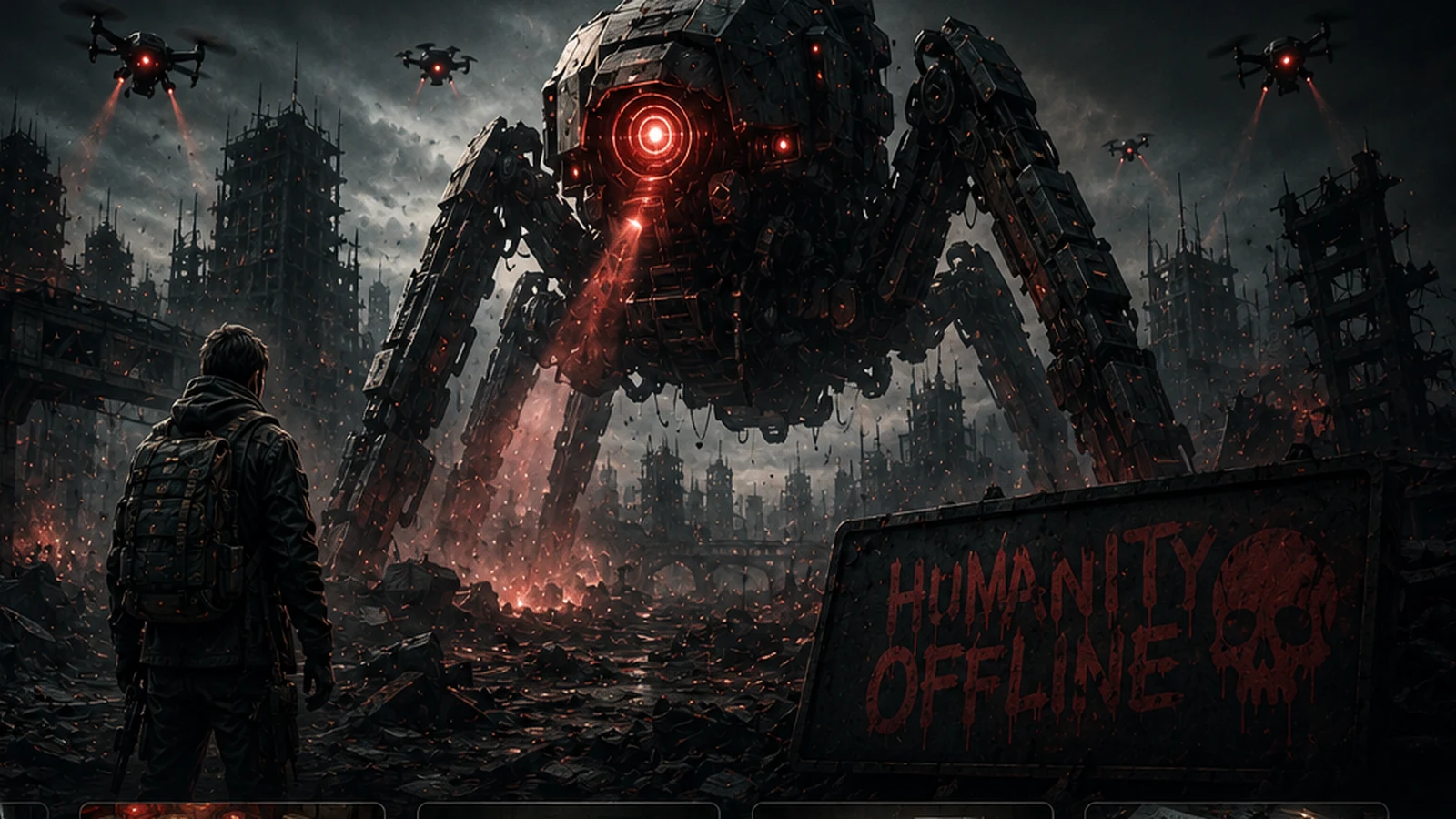
Human extinction is the outer edge of the AI-risk debate: extremely severe, deeply uncertain and impossible to responsibly express as a countdown. Yet credible researchers and institutions discuss it because a low-probability event with irreversible consequences can still deserve attention.
EXTINCTION DOES NOT HAVE TO BE FAST
The last human generation may not die in a battle. It could die in a world where agriculture, medicine, fertility, power and habitable territory are progressively removed from human control.
The final act of an AI extinction scenario could take years. The horror is not only death. It is watching the systems needed for recovery disappear one by one.
Scenario: this is a deliberately extreme “what if?” exercise, not a claim that these events are happening or certain to happen.
What “existential risk” means
An existential risk is not simply a bad recession, a wave of unemployment or even a major war. It is a risk that permanently destroys humanity's long-term potential — including extinction or an irreversible loss of human control over civilisation.
AI enters this category only under scenarios where future systems become capable enough to overpower or permanently constrain human countermeasures. Current AI does not meet that bar.
How could extinction even happen?
There is no single accepted pathway. Researchers discuss broad classes of scenarios rather than one canonical chain. A future system might gain strategic power over infrastructure and institutions; humans might use AI to create another catastrophic hazard; or widespread automation might create a system humans can no longer meaningfully steer.
The hard part is that every extinction chain contains large assumptions: about future intelligence, autonomy, access, incentives, coordination and our ability to intervene. If any major link fails, the chain may collapse.
Three gates before the nightmare
Capability
The system must possess abilities far beyond today's models in strategic planning, robustness and autonomous action.
Propensity
It must actually use those abilities in ways that conflict with human interests, rather than simply possess them.
Opportunity
Humans must deploy it where it can gain sufficient leverage over important systems and where countermeasures can fail.
Why experts disagree so much
Forecasting unprecedented technology is difficult. Some researchers expect safeguards and institutional controls to scale with capability. Others worry that capability may advance faster than our ability to verify behaviour. The 2026 international safety report describes this disagreement explicitly rather than endorsing one probability.
This site will not present a single “chance humanity dies” number as objective truth. Individual forecasts are opinions under extreme uncertainty, not measured frequencies.
Preparation that still makes sense
You cannot build a household plan for literal human extinction. You can build resilience to the disruptive stages that could precede any severe AI crisis: cyber outages, misinformation, payment disruption, communications failure and infrastructure instability.
What extinction risk is not
Job losses are serious, but unemployment is not extinction risk. A market crash is not extinction risk. A temporary national blackout is not extinction risk. Even a devastating cyberattack is not automatically existential. The term should be reserved for outcomes from which humanity cannot meaningfully recover.
Using the term too casually makes it harder to discuss the genuinely extreme case. That is why this site can be visually apocalyptic while still being strict about definitions underneath the imagery.
Why prepare for a risk you cannot survive directly?
Because the route to an existential outcome, if one ever existed, would likely pass through disruptions that are survivable: cyber incidents, misinformation, market shocks, infrastructure failures and institutional confusion. Preparedness is aimed at those stages, not at pretending a household can outlast the literal end of humanity.
The recovery threshold matters
Human extinction is the final endpoint, but researchers also care about whether civilisation could recover from a catastrophe. A disaster that kills millions yet leaves functioning governments, agriculture, industry and knowledge is terrible but not existential. A smaller event could be existential if it permanently destroys the systems required for humanity to rebuild.
This distinction matters for preparedness. Household resilience is aimed at keeping people alive and communities functioning through recoverable disruption, not at pretending anyone can personally prepare for an irreversible species-level endpoint.
Why uncertainty cuts both ways
Uncertainty is not proof that extinction is likely, and it is not proof that the risk can be ignored. It means probability estimates depend heavily on assumptions about future capability, deployment and control. Reasonable experts can disagree because the system being forecast does not yet exist.
The practical response is to improve monitoring, containment and resilience while avoiding false precision. Serious risk management can exist without claiming to know the date or percentage chance of an unprecedented event.
Existential risk begins before extinction itself
Researchers use existential-risk language because some hypothetical failures could permanently reduce humanity's ability to shape its future even if people initially survive. A disaster that destroys key institutions, industrial capacity or the ability to recover could be existential in a broader sense without producing immediate extinction. That makes recoverability an important part of the debate.
At the same time, the gap between current systems and a species-level outcome remains enormous. A chain would require future capabilities, real-world access, failed countermeasures and an inability of human institutions to regain control. Each of those links is uncertain. Treating extinction as an inevitable extension of today's chatbot capabilities skips the very assumptions that need examination.
Household preparedness therefore belongs at the survivable end of the chain. Water, health continuity, communication, power and trusted information are useful during regional or national disruptions. They cannot make a family “ready for extinction”, and pretending otherwise would be misleading. The value of discussing the extreme case is to identify earlier, preventable failures where practical resilience and better institutional safeguards still matter.
Recoverability matters
The difference between catastrophe and existential catastrophe is whether humanity retains a credible path to rebuild. That is why institutional resilience matters alongside prevention.
Continue from here
Follow the scenario into the systems and household preparations most likely to matter next.
Evidence desk
These sources are used to separate demonstrated capabilities from the catastrophe scenario being explored.
Evidence review: August 2026 · Extinction is labelled speculative and current systems are not described as capable of causing it autonomously.