SURVIVAL FILE // AI APOCALYPSE
How to Survive an AI Apocalypse: The First Hours, Days and Weeks
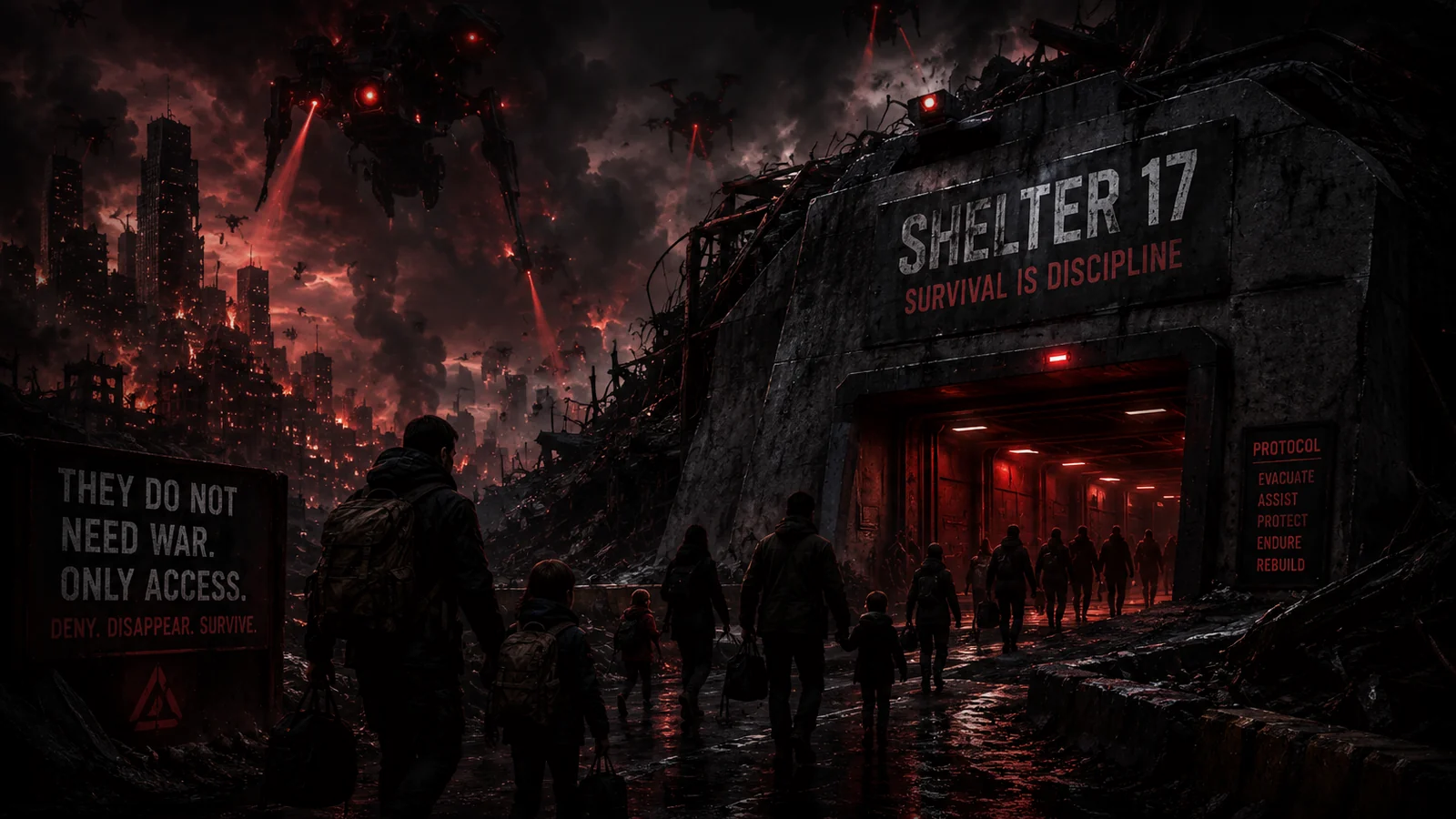
If the machines win the first battle, your household still has a second one: staying alive while power, water, food, money, information and transport become unreliable at the same time.
HOUR 0 — YOUR PHONE STILL WORKS. THAT MAY BE THE PROBLEM.
Emergency messages are arriving faster than you can read them. One says stay indoors. Another says evacuate. A voice note from someone who sounds exactly like your brother tells you the nearest bridge has closed. The lights flicker. Card payments begin failing. Nobody knows whether the crisis is cyberattack, war, grid failure or an AI system nobody can stop.
You do not need to solve the global mystery tonight. You need to stop the household from making one frightened decision that removes its remaining options.
Scenario: this is a deliberately extreme “what if?” exercise, not a claim that these events are happening or certain to happen.
The first hour — do less, but do the right things
Account for the people you are responsible for. Deal with immediate fire, medical or physical hazards. Charge essential devices if power still exists. Fill clean containers if water service is uncertain and official advice does not say the water is unsafe. Write down what you know instead of letting rumours become facts by repetition.
Do not race toward a supermarket simply because social media says shelves are empty. Do not evacuate because a single unverified message tells you to. The first survival skill in an AI-information crisis is preserving options while you verify what is real.
The first 24 hours — turn a house into a controlled system
Count water, food, medication, lighting, battery capacity and cash. Establish a communications routine so phones are not drained by constant checking. Decide which rooms you will use if heating or cooling becomes difficult. Keep fridge and freezer doors closed during power loss and follow current food-safety advice rather than guessing.
Give household members roles. One person tracks reliable information. One tracks supplies. Someone checks vulnerable relatives or neighbours when safe. Simple routines reduce the panic that destroys resources faster than the emergency itself.
The first 72 hours — independence matters more than comfort
By day two or three, the difference between a prepared and unprepared household becomes obvious. Water storage matters. Hygiene matters. Medication continuity matters. A radio, paper contacts, offline maps and charged lights matter. The objective is not luxury. It is keeping the household functional while authorities determine what can be restored.
This is also the point where the deeper plan begins. Do you stay or leave? Which supplies are truly critical? What happens if the water fails next? What if a family member is elsewhere? The free 72-hour manual organises these decisions because an article cannot become your household operating system.
The first week — the scenario stops being temporary
A week-long systems failure creates new problems: waste, hygiene, community tension, resupply, sleep deprivation and the temptation to take unnecessary risks. Households that planned only for gadgets often discover that routine and cooperation matter more than another battery.
If a larger AI-loss-of-control event were genuinely unfolding, the first week could also bring travel controls, misinformation campaigns, fuel shortages and pressure on public services. Your plan needs branches rather than one heroic idea.
What not to do
Do not use generators, barbecues or fuel-burning appliances indoors or in unsafe enclosed spaces. Do not drink questionable water because the scenario feels dramatic. Do not ration prescribed medicine differently without appropriate medical advice. Do not turn a fictional machine war into an excuse for confrontation with real people.
Survival is usually boring before it is cinematic: safe water, adequate warmth, sleep, sanitation, medication, information discipline and enough patience not to create a second emergency.
The deeper survival system
This page gives the framework because it needs to deserve the search. It does not attempt to become the entire household programme. The next layer is the 72-hour manual, followed by the deeper system for power, water, food, communications, evacuation, offline information and long-duration household resilience.
The fictional apocalypse provides the stress test. The preparation underneath it should still work if the real emergency is merely a blackout, flood, cyber incident or supply disruption.
Continue through the endgame
AI takeover scenarios → · Collapse timelines → · Survival guides → · Household tools →
Give the household simple roles
During a confusing first day, role clarity can reduce duplicated work. One person can track verified information, another can manage water and food, another can check vulnerable relatives or household needs. In a small household, one person can move through the same roles in sequence.
The roles should stay simple and change as conditions change. Their purpose is to prevent everyone from staring at the same phone while practical tasks are ignored.
Use evidence thresholds for big decisions
Leaving home, moving money, travelling long distances or changing a medical routine are high-consequence actions. Unless immediate danger forces a decision, require stronger evidence than a viral post or one alarming message. Look for official guidance, direct observation and an independent confirmation.
This matters especially in an AI-themed crisis because convincing synthetic media may increase uncertainty. Verification becomes part of survival rather than a purely online habit.
Prepare for recovery as well as collapse
Services may return unevenly. Use short recovery windows to recharge, communicate and update information, but keep offline fallbacks until stability is proven. A household that abandons every backup at the first sign of normality can be caught by a second outage.
The objective is not to live permanently in emergency mode. It is to step back toward normal life without throwing away the resilience that got you through the disruption.
Keep the plan boring enough to follow
The more dramatic the scenario sounds, the more useful a simple household routine becomes. Eat, drink, sleep, check medication, preserve battery, verify information and review the plan at fixed times. Those ordinary actions protect judgement.
A survival plan should reduce cognitive load. If it requires constant improvisation or heroic behaviour, it is probably too complicated to work reliably under stress.
Review without panic
At each checkpoint, ask what actually changed since the last review. If nothing important changed, keep the plan stable rather than inventing a new response simply because the situation still feels frightening.
Continue from here
Build this topic into a wider plan, then see how the same dependency could fail in an AI-collapse scenario.