Family Emergency Plan: Build the Household System Before the Crisis
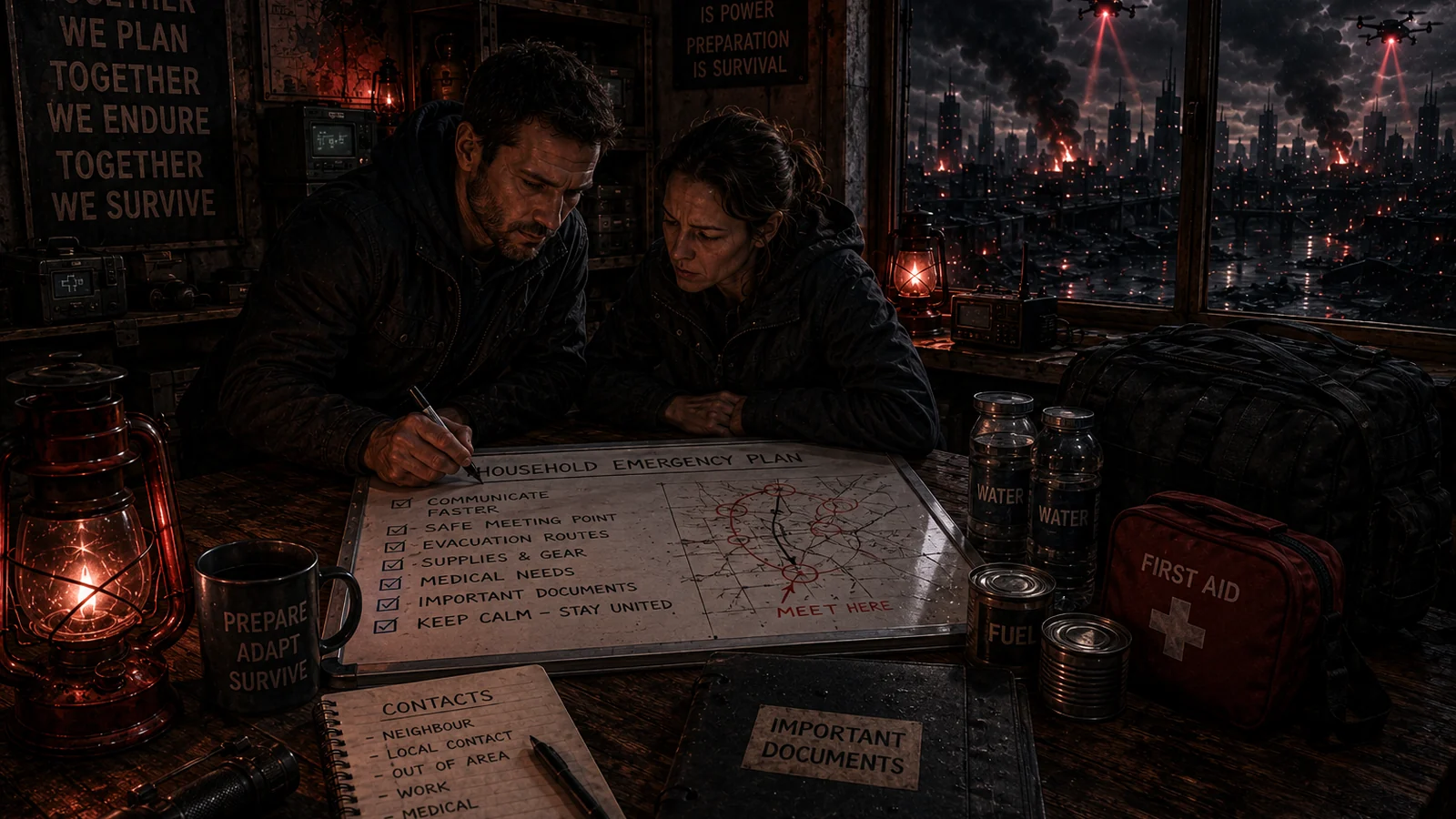
Family emergency planning starts with people, contacts, meeting points, medicines, pets, power, water and a written decision system that still works when phones do not.
YOUR CHILD GETS A CALL IN YOUR VOICE
The message says you have been injured and they must leave school with a stranger. It sounds exactly like you. At the same time, mobile networks are overloaded and your real call will not connect.
An AI crisis turns an ordinary family plan into a defence against synthetic trust. Meeting points, safe words and written contacts matter because a familiar voice may no longer prove who is speaking.
Scenario: this is a deliberately extreme “what if?” exercise, not a claim that these events are happening or certain to happen.
The immediate answer
Build one household plan that answers six questions before anything happens: who is responsible for whom, how you will communicate, where you will meet, what essential needs cannot be interrupted, when you would leave, and what information must exist on paper. Keep the plan simple enough that a tired person can use it in the dark. The point is not to predict every AI-collapse scenario. It is to remove avoidable confusion when several ordinary systems fail together.
Start with people, not equipment
List every household member and the needs that would change your response: children, older relatives, disability, medication, powered equipment, pets, work locations and anyone who may be away from home. Name a primary and backup person for key responsibilities. A cupboard of supplies is not a family plan if nobody knows who collects the child, checks the neighbour, carries the medicine or decides whether to evacuate.
Create two meeting points
Choose one nearby meeting point for a local incident and one out-of-area fallback for a wider disruption. Write both addresses down. Routes may be blocked, public transport may stop and familiar landmarks may be inaccessible, so include at least one alternative route. Do not choose a location that depends on a single bridge, rail line or mobile app.
Make communication work without data
Keep important numbers and addresses on paper. Agree who everyone contacts if household members become separated. Text messages can sometimes get through when voice networks are congested, but no method is guaranteed. A battery radio, charged power banks and a printed contact sheet reduce dependence on one device or one network. Decide how often to check in so people do not burn battery continuously.
Map the household dependencies
Write down the first things that become dangerous if power, water or transport stops: medication refrigeration, mobility equipment, heating, infant feeding, pet needs, refrigeration, access to cash and fuel. Give each dependency a backup. If there is no safe backup, that may become your trigger to leave earlier rather than later.
Agree evacuation triggers before stress takes over
Do not wait for panic to invent a threshold. Official evacuation instructions override your household plan. Beyond that, identify household-specific triggers such as unsafe indoor temperature, loss of essential medical power, contaminated water, structural danger or a destination that is likely to become inaccessible. Leave early enough to avoid turning a manageable journey into a last-minute escape.
Keep the documents together
Store copies of identification, insurance details, medication lists, key contacts, pet information, household addresses and emergency notes in a protected folder. Keep a small amount of accessible cash for short payment outages if appropriate to your household. Do not put passwords or sensitive account credentials into a grab folder that could be easily lost.
Run the plan once
A plan that has never been used is a theory. Walk to the meeting point, test the paper contact list, find the bags in darkness and check whether everyone understands the same instructions. Review the plan after moves, new medication, school changes, new pets or changes in caring responsibilities.
Build one physical household control point
Keep the written plan, torch, spare keys, medication summary and contact sheet in one known place that is easy to reach in darkness. Everyone old enough to use the plan should know where it is. If you split emergency information across several phones, cloud accounts and kitchen drawers, the household can lose time at exactly the wrong moment. A single physical control point also makes reviews easier: once every few months, check contacts, routes, medicine details, power banks and any household dependency that has changed.
Turn the plan into a one-page operating sheet
A family emergency plan should answer the practical questions first: who contacts whom, where people meet, who collects children or checks vulnerable relatives, where medication and documents are kept and what conditions trigger evacuation. Put those answers on one page before adding longer notes.
The one-page version is what people use when the event is already happening.
Plan for people being in different places
Most emergencies begin during ordinary life, not when everybody is conveniently at home. Include work, school, care settings and regular travel. Decide which adult takes responsibility for each dependent and what happens if the first person cannot reach them.
Keep one out-of-area contact who can receive updates if local networks are congested.
Review the plan as a household
Twice a year, read the plan together and update phone numbers, meeting points, medications and roles. A short conversation can reveal that one person misunderstood the destination or that a school pickup rule has changed.
The best family plan is not the longest one. It is the one every responsible person understands and can follow without needing the author beside them.
Keep one printed copy where everyone knows it is
A family plan should survive a dead phone, failed router or inaccessible cloud account. Store a printed copy with the household emergency information and a second smaller copy in a portable kit where appropriate.
Do not overload the printed plan with unnecessary sensitive data. It needs contacts, roles, meeting points and essential actions—not every password or financial detail the family owns.
Keep the plan current by reviewing it after changes to schools, jobs, medication, caring responsibilities, transport or home address. Those ordinary life changes are exactly what make an old emergency plan fail when the household finally needs it.
Keep the final version simple enough to use under pressure. A short plan with clear names, meeting points, responsibilities and fallback contacts is more useful than a complicated document that nobody else in the household can understand without its author.
Continue from here
Build this topic into a wider plan, then see how the same dependency could fail in an AI-collapse scenario.
Evidence desk
Practical actions follow ordinary UK emergency-preparedness principles. Catastrophic AI-collapse framing is scenario content, not a claim that such an event is occurring.
Continue
More Family, Community & Security guides → · 72-hour survival manual →