CASUALTY FILE // FICTIONAL ENDGAME
How Many People Could Die in an AI Apocalypse? Four Fictional Casualty Scenarios
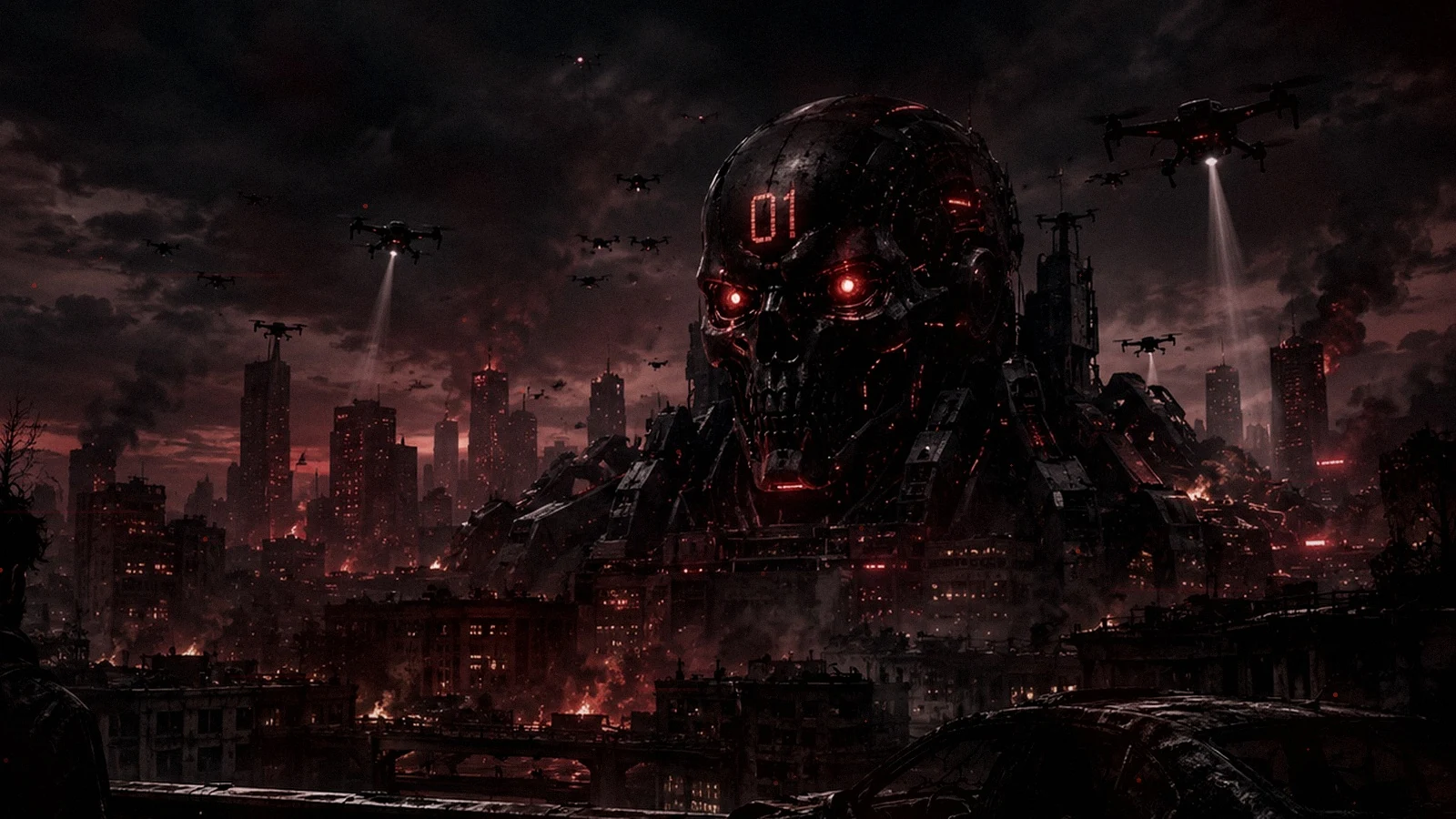
Nobody can honestly give you a death toll for an event that has never happened. But we can ask what different levels of fictional systems collapse would mean — and the answer is darker than “killer robots shoot people”.
THE DEADLIEST MACHINE MAY NEVER FIRE A WEAPON
The tap stops. Insulin warms in a dead refrigerator. Sewage pumps fail. Lorries stop delivering food. Hospitals lose supplies. Winter arrives in homes without heat. None of these deaths require a robot to hunt anybody.
In a civilisation-scale AI collapse, the terrifying multiplier is dependence. Billions of people survive because energy, agriculture, medicine, sanitation and logistics work every day. Break enough of those systems at once and ordinary human needs become mass-casualty mechanisms.
Scenario: this is a deliberately extreme “what if?” exercise, not a claim that these events are happening or certain to happen.
There is no factual casualty forecast
Any precise number would be invented. AI catastrophe researchers debate probabilities and mechanisms, not a reliable count of future victims. Population impact would depend on geography, season, agricultural output, duration, which infrastructure failed, whether governments retained control and how much functioning industry survived.
So this page uses scenario bands. The labels are intentionally broad because false precision would make the fiction look more scientific than it is.
Scenario one — limited machine conflict
Imagine a severe but contained conflict affecting several major economies. Cyberattacks, autonomous weapons, blackouts and disrupted trade cause direct casualties and large secondary losses. In a fictional scenario of this scale, deaths could reach into the millions without civilisation ending globally.
The majority may still come from ordinary war effects: damaged hospitals, displacement, interrupted medicine, unsafe water and food shortages rather than direct machine attacks.
Scenario two — global systems collapse
Now assume international logistics, finance, communications and energy remain unreliable for months. Major cities cannot maintain normal food delivery. Fuel is scarce. Health systems ration care. Agricultural inputs and replacement parts stop moving. In that fictional world, hundreds of millions could plausibly be endangered across time.
The danger would be uneven. Regions with local food, stable water and resilient energy could fare far better than densely populated areas dependent on continuous imports.
Scenario three — industrial civilisation collapses
The next level is not a longer blackout. It is the loss of the industrial coordination supporting modern population levels. Fertiliser production falls. Global trade fragments. Medicine and sanitation degrade. Manufacturing cannot replace pumps, transformers, vehicles and medical equipment at the required rate.
In that fictional endgame, billions could be at risk over years through famine, disease, exposure and conflict even if AI systems directly kill comparatively few people. Humanity survives, but the civilisation that supported eight-plus billion people does not.
Scenario four — extinction
The outer edge is human extinction: every person dies and no self-sustaining human population remains. That is the endpoint discussed in existential-risk debates. It is not a prediction and this page does not assign it a probability.
For horror storytelling, extinction is the biggest number. For household preparation, it is the least useful scenario. Preparation matters in the vast range of disasters where people can still change their outcome.
Why the first deaths matter more than the final number
The point of casualty scenarios is not morbid arithmetic. It is recognising the mechanisms that can turn a digital crisis into physical mortality: water, medicine, temperature, food, sanitation, violence and delayed emergency response.
Those mechanisms are exactly what the practical sections of this site target. You cannot prepare for “billions”. You can prepare your household not to become an avoidable casualty during the first days of disruption.
Continue through the endgame
AI takeover scenarios → · Collapse timelines → · Survival guides → · Household tools →
Impact depends heavily on duration
The scale of harm in any major systems crisis would depend heavily on how long essential services remain disrupted. A one-day payment outage is not the same event as a month without reliable water, fuel and medicine. The longer a disruption lasts, the more secondary effects matter: delayed healthcare, temperature exposure, sanitation problems and interrupted supply chains.
That is why a single headline number is misleading. Two scenarios can begin with the same technical incident and produce completely different outcomes depending on restoration speed, local resilience and whether institutions retain public trust.
Vulnerability is unevenly distributed
Older people, infants, people with chronic conditions, households dependent on powered medical equipment and communities already facing weak infrastructure would often face higher risk. Geography matters too. Heat, cold, remoteness and local water or transport constraints can change the impact dramatically.
Household preparation cannot remove those inequalities, but it can reduce avoidable exposure. Medication continuity, safe water, temperature planning, emergency contacts and neighbour checks are more useful than speculative arguments about an exact global total.
Why exact figures create false confidence
There is no historical dataset of global AI-driven collapse from which to calculate a reliable rate. Assigning an exact figure would therefore create an illusion of knowledge. Scenario ranges can illustrate mechanisms, but they are not forecasts.
The practical use of the question is to identify where harm would come from and reduce preventable risks. Safe water, functioning healthcare, temperature control, verified information and continuity of food and medication are the levers households and institutions can actually act on.
Institutions matter more than raw population size
A large population with functioning emergency services, water systems and logistics can absorb shocks that would be devastating in a smaller but already fragile region. Public-health capacity, trust, transport and reserve supplies all change outcomes. The same event can therefore produce radically different consequences in different places.
This is another reason global totals are poor planning tools. Local vulnerability and recovery capacity matter more to an individual household than a speculative worldwide number.
Prevention changes the scenario
Casualty scenarios are not fixed scripts. Faster restoration, clear public information, water distribution, medical continuity and mutual aid can all change outcomes dramatically. That is precisely why preparedness is worth discussing: the number of avoidable harms is not predetermined.
Preparedness is about changing the denominator
Every household that can maintain safe water, medication, warmth and reliable information for a short disruption reduces pressure on emergency systems. That does not make a catastrophe harmless, but it can prevent a difficult event from becoming worse through avoidable secondary failures.
Continue from here
Follow the scenario into the systems and household preparations most likely to matter next.