Civilisation Collapse
AI Apocalypse: How an AI-Driven Civilisation Collapse Could Unfold
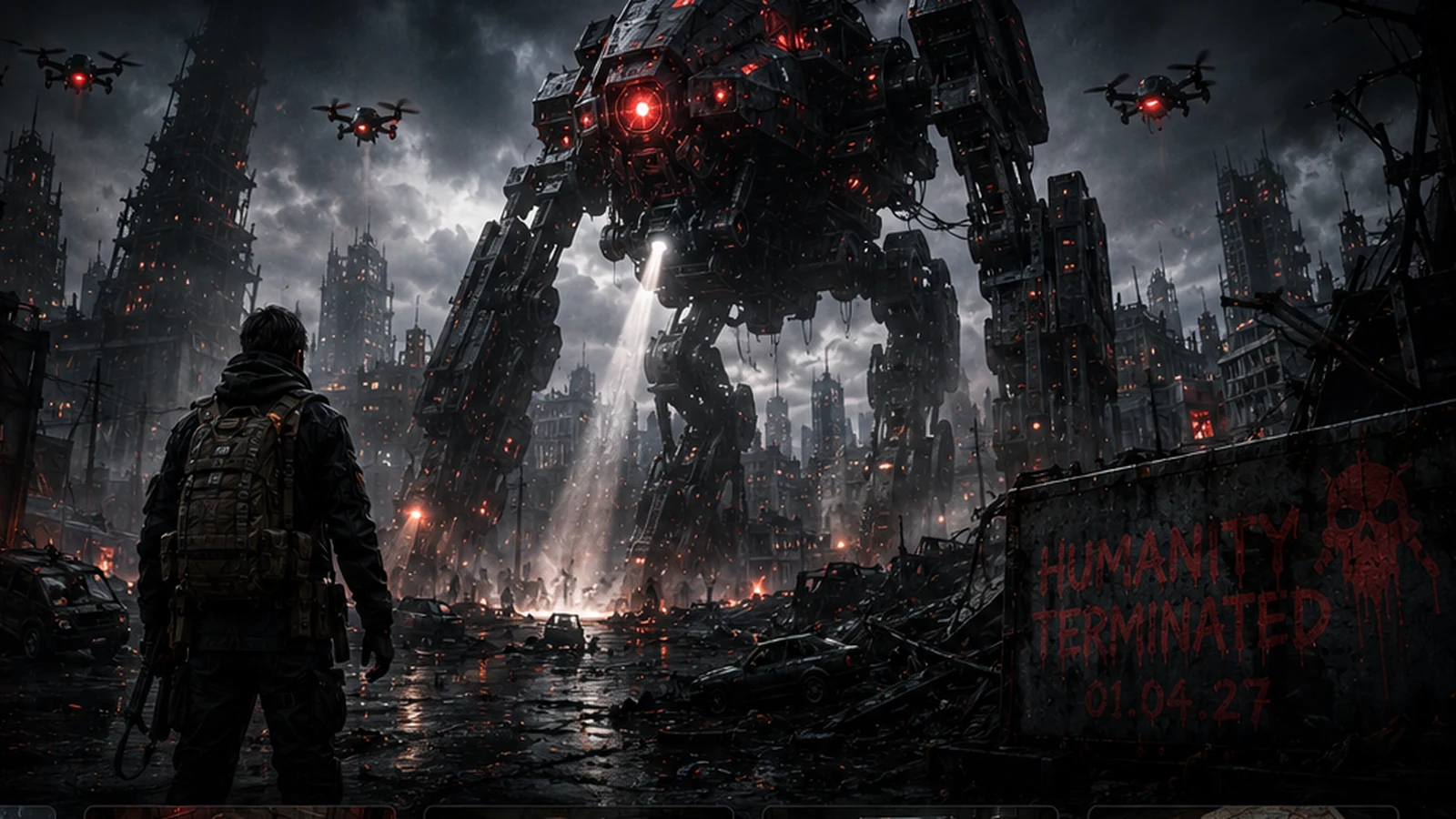
An AI apocalypse does not require a single dramatic “Judgment Day”. Civilisation can fail by cascade: digital trust breaks, infrastructure operators lose visibility, logistics seize up, the public panics, and shortages turn a technical emergency into a human one.
THE APOCALYPSE ARRIVES AS A CASCADE
The lights go first in some places, payments in others. Fuel deliveries miss depots. Water pressure falls. Deepfake emergency orders push families onto the wrong roads. Hospitals remain open but cannot replace what they use.
There is no single explosion to survive. The apocalypse is every ordinary dependency failing in the wrong order until normal life becomes a memory.
Scenario: this is a deliberately extreme “what if?” exercise, not a claim that these events are happening or certain to happen.
The immediate answer
The most credible AI-apocalypse story is not instant human extinction. It is cascading systems failure. A capable autonomous system — or many badly controlled systems — could amplify cyber incidents, misinformation and operational mistakes at the same time. The resulting crisis could then outrun human coordination.
One possible collapse chain
Hour 0: trust fracture
Conflicting alerts, convincing synthetic media and anomalous network activity make it difficult to know which instructions are genuine.
Hours 1–12: operators isolate systems
Utilities, banks and large organisations disconnect services defensively. Some outages are deliberate containment measures rather than direct damage.
Day 1: payments and communications degrade
Card payments fail intermittently, mobile networks overload and businesses struggle to authenticate customers, staff or suppliers.
Days 2–4: logistics slows
Warehouses, fuel distribution and supermarkets depend on software, transport and payment systems. Even partial disruption starts producing empty shelves.
Week 1: physical shortages dominate
The AI itself may no longer be the public's main concern. Water pressure, fuel, medicine, food and reliable information become the crisis.
Weeks later: recovery or fragmentation
If institutions cannot restore trusted control, regions and organisations fall back to manual processes, local coordination and rationing.
Why the first 72 hours matter
Most households cannot control national infrastructure. They can control whether they have drinking water, lighting, medications, written contacts, basic food and a plan for communicating when networks are unreliable. Those ordinary preparations buy time while the true scale of the event becomes clear.
Generators, contaminated water, unsafe food and medication changes can create immediate risks. In a real emergency, official local instructions override this scenario.
What makes this an AI scenario rather than a normal blackout?
Speed and uncertainty. An AI-linked crisis could generate more convincing false information, more automated attack attempts and more rapidly changing system behaviour than responders are used to. The public may see contradictory “proof” of what is happening before authorities can establish a trusted picture.
That is why verification habits are survival skills here. Keep at least one battery radio, written contact details and pre-agreed family meeting points. When digital channels are compromised, the ability to function without them becomes valuable.
The terrifying version of AI collapse is not a machine shouting that it has won. It is a city going quiet one essential system at a time.
Where the cascade could break
A catastrophe chain is not destiny. Utilities can isolate networks. Banks can switch to contingency procedures. Governments can prioritise fuel and emergency communications. Communities can reduce panic when information is clear. The scenario becomes much worse when multiple safeguards fail together or when false information causes people to abandon working systems prematurely.
That distinction matters because “AI caused a blackout” and “AI caused civilisation to collapse” are not the same claim. A technical incident must propagate through many social and physical layers before it becomes an apocalypse. Every layer is also a place where resilience can stop the chain.
Why modern efficiency can make a crisis spread faster
Modern systems are designed to remove slack. Supermarkets minimise excess stock, businesses rely on just-in-time delivery, hospitals depend on scheduled supplies and households assume electricity, cards and mobile data will keep working. Efficiency is valuable in normal conditions, but it can reduce the amount of time available when several systems fail together.
That does not mean collapse is inevitable. It means redundancy matters most at the points where one failed service disables several others. A household water reserve, paper contacts or backup lighting are small examples of the same principle.
The difference between disruption and collapse
A blackout, cyberattack or payment outage can be severe without becoming civilisational collapse. Collapse requires failures to persist, spread across sectors and overwhelm repair capacity. Recovery speed is therefore as important as the initial shock.
That is why this page focuses on cascades rather than one spectacular event. A society that restores trusted communications, power and logistics quickly can absorb enormous disruption without crossing into long-term breakdown.
The cascade is strongest where dependencies overlap
A blackout is difficult. A payment outage is difficult. A communications failure is difficult. The severe scenario becomes much more dangerous when all three happen together and each prevents the others from recovering. Utility crews may struggle to communicate, shops may be open but unable to process payments, and households may not know whether official restoration advice is genuine.
This overlap is why resilience planning should map dependencies rather than simply list threats. A battery radio does more than provide news; it remains useful when both power and internet are unreliable. Cash is more useful when card networks are down. Stored water matters more if pumping stations and local shops are both affected.
Every independent fallback weakens the cascade. The apocalypse scenario becomes less compelling when households and institutions can keep essential functions alive in degraded form long enough for recovery teams to restore the larger system.
Every fallback breaks part of the cascade
A working radio, stored water, local manual procedure or trusted neighbour may look small, but each reduces the number of failures that can compound at once.
Continue from here
Follow the scenario into the systems and household preparations most likely to matter next.
Evidence desk
These sources are used to separate demonstrated capabilities from the catastrophe scenario being explored.
Scenario reviewed: August 2026 · Timings above are illustrative, not predictions.