SURVIVAL GEAR & PRACTICAL SKILLS
30-Day Resilience Checklist: Build a Household That Can Absorb a Long Disruption
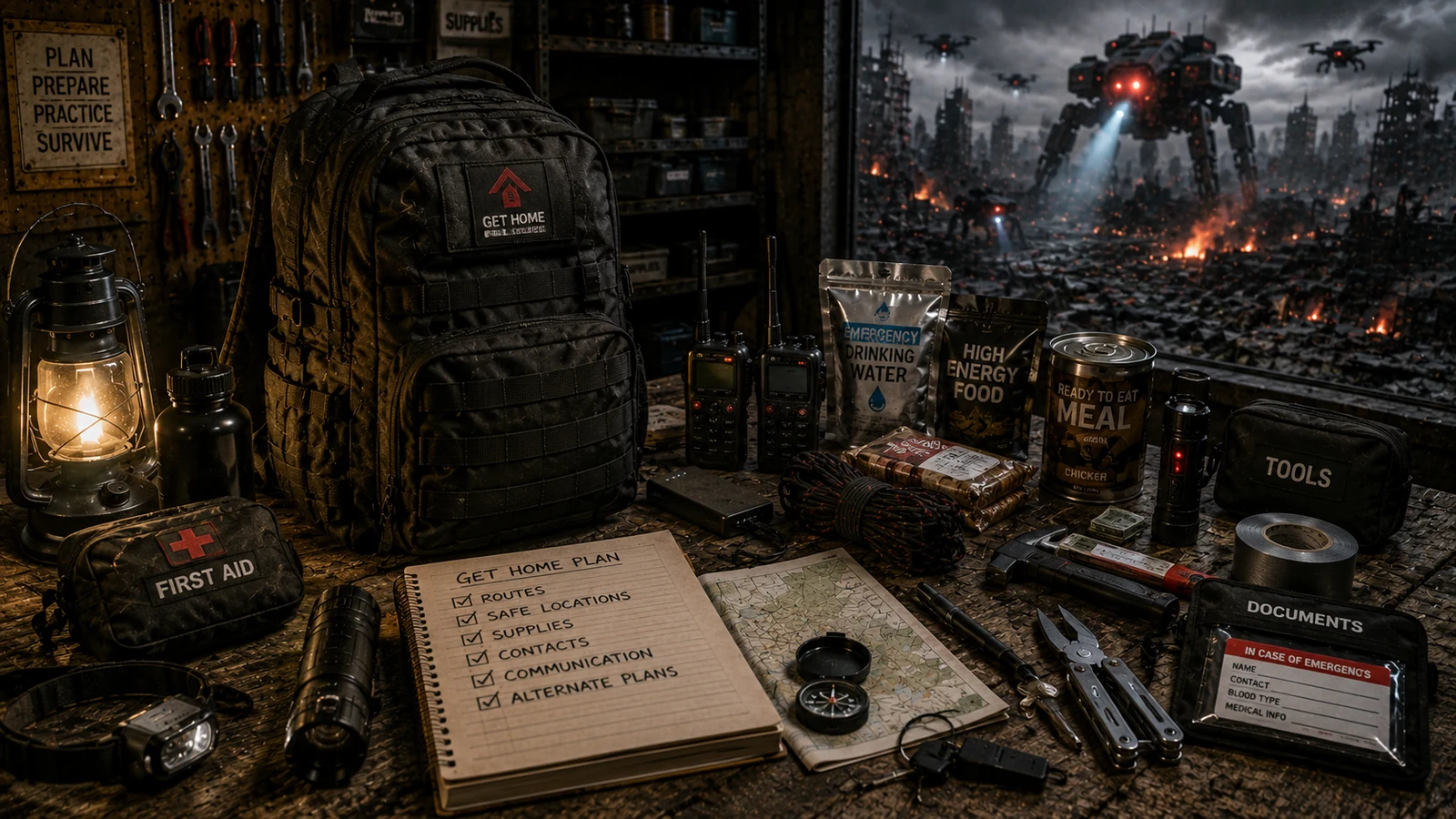
A 30-day resilience checklist for households planning beyond the first 72 hours without turning preparedness into an unrealistic bunker project.
The immediate answer
Thirty-day resilience is not simply “buy thirty times more stuff”. It is about reducing dependencies that become expensive, dangerous or impossible during a prolonged disruption. Start with water planning, food rotation, medication continuity, backup power for genuinely essential loads, safe cooking, sanitation, cash access, paper information, household communication and a realistic plan for when staying home stops being sensible. Build in stages so every purchase solves a known weakness.
Week 1: master the basics
Before extending supplies, prove the household can manage three to seven days safely. Track real water use, food consumption, device charging and medication needs. Test your radio, power banks, lighting and no-power meals. Identify which assumptions fail. A household that wastes half its battery in the first day or discovers nobody eats the emergency food will not become resilient by buying four more weeks of the same plan.
Water beyond three days
Long-duration water planning becomes a storage and replenishment problem. Drinking water alone is only part of demand; cooking, hygiene, pets, infants and medical needs can increase it sharply. Use clean, appropriate containers and understand how you would respond to official boil-water or do-not-use notices. Do not assume that one filter or boiling method handles every contaminant. Identify legitimate backup collection or supply points likely to exist in your area.
Food that rotates instead of expires
Build a pantry from normal shelf-stable food and meals that require little energy. Rotate it through everyday cooking. Track calories only if it genuinely helps; for most households, familiar balanced meals, allergies, dietary needs and cooking constraints matter more than survival branding. Plan for refrigeration loss and keep at least some food that does not require a hob. Add a manual can opener and enough safe cooking capability for the foods you store.
Power: size to essential loads
List devices by necessity and energy demand. Phones, radios and small lights can be supported relatively easily; heating, cooking and high-power appliances change the calculation dramatically. If someone relies on medical equipment, follow manufacturer and clinical advice rather than treating generic power-station marketing as medical guidance. Solar may extend endurance but depends on conditions, siting and equipment. Test the actual load plan before assuming a battery capacity will last a month.
Health, sanitation and waste
Keep legitimate medication continuity plans, first-aid supplies and hygiene items. Consider how rubbish, toilets, washing and hand hygiene would work if water or collection services were interrupted. Long disruptions create health risks through poor sanitation and unsafe improvisation. Build enough supplies to keep routines clean and boring. If conditions become unsafe, relocation may be a better resilience decision than trying to force the household to remain in place for thirty days.
Money, documents and community
Maintain paper copies of essential contacts and useful documents, and consider a modest cash reserve for short payment-system failures. Know neighbours and vulnerable people nearby. Shared information, tools and practical help can stretch resilience far further than isolated stockpiles. Avoid displaying supplies or creating an adversarial atmosphere. A thirty-day plan should include how you give and receive help, not only what sits behind your own front door.
The monthly drill
Once or twice a year, run a short resilience weekend using only part of the emergency system. Do not simulate danger; simply test equipment, meals, lighting, radio, charging and paper plans. Record what failed. Update quantities after household changes, medication changes, new pets, new devices or a house move. Thirty-day resilience is a maintained capability, not a date-stamped shopping list.
Do the maths on storage before buying
Thirty days of supplies occupies real volume and weight. Water is usually the limiting factor, while food, hygiene products, batteries and pet supplies compete for the same storage space. Measure the cupboard, shelf or under-bed area you actually have and check what weight it can safely support. Build the reserve around realistic storage instead of fantasy quantities. If the plan cannot physically fit, it needs replenishment routes, shared community resources or an earlier relocation trigger rather than another online shopping list.
Continue building the system
Thirty days needs replenishment, not just storage
A month-long plan cannot assume every item simply sits untouched until needed. Water, food, hygiene supplies, batteries and medication all have different replacement cycles. The stronger approach is to build normal household use around the reserve so stock is constantly rotated and familiar.
Write down the few items that would be genuinely difficult to replace during a long disruption and give them earlier attention than generic bulk supplies.
Plan the month in phases
The first three days are about immediate continuity. The first week is about routine. Weeks two to four are about sustainable use, safe replenishment and preventing fatigue from turning into bad decisions. A plan that treats all thirty days the same usually wastes resources early.
Create checkpoints at day three, day seven and day fourteen. At each point, recount supplies, review health needs and decide whether staying put still makes sense.
Community support becomes part of the thirty-day plan
No household can cheaply duplicate every skill, tool or supply for a month. Trusted neighbours, family and local organisations can reduce that burden. Know who may need help, who has practical skills and which local services are likely to coordinate support.
Long-duration resilience is partly social infrastructure. A well-supplied household that has no information, transport or trusted contacts can still become vulnerable.
Track consumption during a normal week
Before estimating a month of supplies, observe what the household actually uses. Note how quickly common food staples, toiletries, pet supplies and batteries are consumed. Real usage is more accurate than multiplying a generic checklist by thirty.
You may discover that some items last far longer than expected while others disappear surprisingly quickly. That information lets you build a reserve around reality and reduces overbuying.
Do not try to turn every consumable into a thirty-day stockpile at once. Start with items that are cheap, stable and routinely used, then add household-specific needs gradually. A rotating system built over time is easier to maintain than a large one-off purchase that expires together.
Measure what actually improves resilience
The goal is not to own thirty days of everything. It is to extend the household's ability to stay safe. Prioritise safe water, health needs, food, sanitation, communication and warmth before adding comfort items that do not change the outcome of a prolonged outage.
Leave room for change
A thirty-day plan should not assume every day will be equally difficult. Preserve some flexible supplies and money for problems you did not predict instead of allocating everything on day one.
Continue from here
Build this topic into a wider plan, then see how the same dependency could fail in an AI-collapse scenario.