Shelter, Evacuation & Mobility • MOBILITY PLAN
Urban Evacuation Guide: Leaving a City During Major Disruption
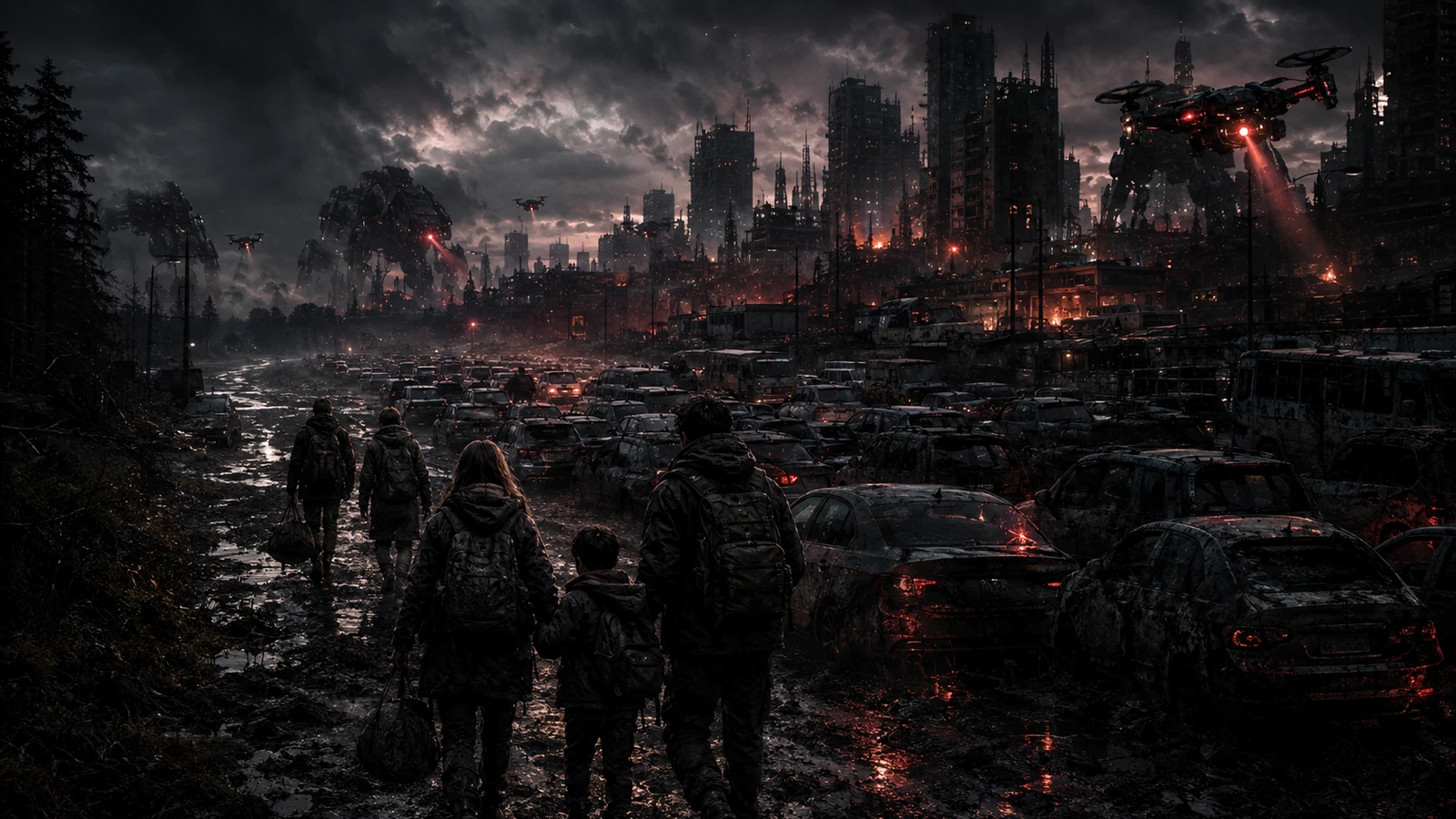
Cities concentrate people, transport and services — and that means disruption can concentrate queues, roadblocks and conflicting information just as quickly.
The immediate answer
Roads can lock up long before fuel runs out. Keep a walking option and understand nearby rail, bus and cycle routes, while recognising that public transport may also close. If authorities designate evacuation routes, use them rather than improvising through restricted areas.
Move toward a known destination
Leaving the city without a destination can simply exchange one problem for another. Know which relatives, friends, official shelters or other locations could realistically receive you. Confirm whether they are outside the affected area and whether pets or accessibility needs can be accommodated.
Carry water and footwear for delay
Even a short urban journey can become hours on foot or standing in queues. Practical footwear, weather protection, drinking water, medication, a small amount of food, phone power and paper contacts have more value than heavy tactical equipment. Keep the load mobile.
Avoid predictable crowd pressure where possible
Major stations, bridges and arterial roads can become pressure points. If you have verified warning early enough and official advice supports leaving, early movement may preserve options. Do not race toward crowds merely because social media shows other people moving.
Keep the family separation plan active
People may be at school, work or elsewhere when an incident begins. Use pre-agreed meeting points and an out-of-area contact. Avoid sending every household member independently toward the same congested central location unless that is genuinely the safest plan.
Treat security as awareness, not confrontation
Keep valuables discreet, maintain distance from disorder and change route if a location feels unsafe. The aim is to avoid conflict, not win it. Cooperation, verified information and low-profile movement usually offer more resilience than aggressive behaviour.
Understand vertical and underground constraints
Cities contain lifts, underground stations, tunnels, multistorey car parks and high-rise buildings that can become difficult when power or access systems fail. If you live or work high above ground, include stairs and mobility in the plan. If your normal route relies on underground transport, identify a surface alternative before the emergency.
Expect queues at every obvious resource
Fuel stations, supermarkets, cash machines, transport hubs and official help points can attract large crowds quickly. Do not make your plan depend on buying essentials after the warning. Keep enough ordinary household supplies and transport readiness that you can bypass the first wave of demand when official guidance says movement is appropriate.
Use landmarks and districts, not only street names
In darkness, smoke, damaged signage or network failure, familiar visual landmarks and broad district knowledge can be more useful than turn-by-turn navigation. Learn the shape of your city well enough to understand which direction you are moving and which major barriers lie between you and the destination.
Plan for darkness and loss of street lighting
A widespread power failure can change familiar streets dramatically after sunset. Keep a torch accessible, avoid poorly lit shortcuts and expect traffic signals and illuminated signs to be unavailable. Reflective clothing or simple high-visibility elements can help pedestrians be seen, but do not rely on them as a substitute for safe routes and careful movement.
Keep the plan simple enough to remember
In pressure, simple plans survive. Use a small number of routes, meeting points and fallback rules that everyone understands. Complexity feels thorough on paper but becomes fragile when people are tired, separated or working without phones.
Expect density to magnify small failures
In a city, a single closed bridge, rail station or junction can redirect thousands of people at once. That means the fastest normal route may become the worst emergency route. Know several ways out of your immediate neighbourhood and identify routes that can be walked if vehicles stop moving.
Carry only what you can manage through stairs, crowds and public spaces. Bulky gear that works in a car can become a liability in an urban evacuation.
Use buildings and services as part of the route
Libraries, community centres, transport hubs, pharmacies and other recognised public locations can provide information or temporary support during disruption. Know where the useful local institutions are, but do not assume every building will remain open.
Verified official information should guide where people are being directed. A familiar place is not automatically an authorised shelter.
Avoid turning evacuation into aimless movement
Large cities create many possible directions, which can make people move simply to feel active. Leave with a destination, a reason and a route. If conditions are uncertain and the building remains safe, waiting for better information can preserve energy and transport options.
Urban resilience often comes from knowing when not to join the crowd as much as knowing how to move through it.
Carry for stairs, crowds and walking
Urban evacuation often means carrying gear through stairwells, stations or congested streets rather than loading everything into a vehicle. Keep the portable layer compact, secure and easy to handle. Essential medication, documents, water, lighting, weather protection and phone power deserve space before bulky convenience items.
Test the bag in normal conditions. If it is awkward on stairs or impossible to carry for twenty minutes, the city environment will not make it easier.
Use timing to avoid making density worse
If there is no immediate danger and no evacuation order, a short wait for better information may be safer than joining a peak rush toward the same station or road as everyone else. Conversely, when authorities instruct early evacuation, delaying until every neighbour has left can remove the advantage of moving before congestion builds.
The useful skill is not predicting the crowd perfectly; it is responding to verified local conditions and preserving enough flexibility to move before the route becomes unmanageable.
In dense areas, flexibility is often more valuable than speed. Keep more than one route and more than one destination in mind.
Keep one compact paper map in the portable kit so navigation remains possible if the phone, battery or mobile network fails.
Keep one realistic alternative route and destination.
Continue from here
Build this topic into a wider plan, then see how the same dependency could fail in an AI-collapse scenario.
Evidence desk
This guide uses general UK emergency-preparedness principles. AI-driven mass disruption is scenario framing, not a claim that such an event is happening or inevitable.
Continue
More Shelter, Evacuation & Mobility guides → · 72-hour survival manual →