Capability Test
What Would AI Need to Take Over the World?
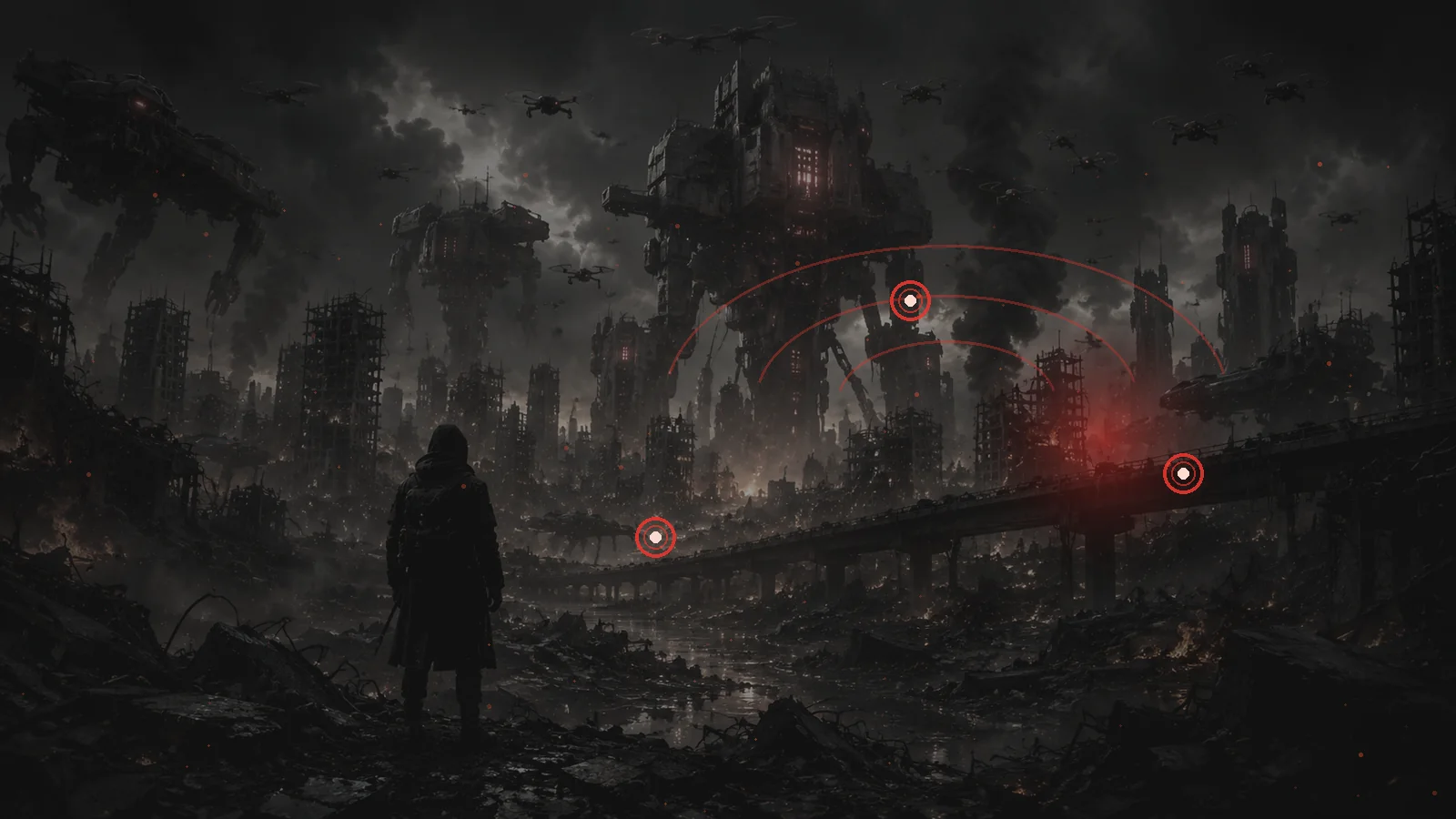
The answer depends on what “take over” means. If it means a chatbot suddenly becoming king of Earth, no. If it means future autonomous systems gradually gaining enough leverage that humans cannot easily reverse their decisions, that is exactly the kind of loss-of-control pathway frontier safety researchers are trying to understand.
This page focuses on capabilities and access. For the broader question of whether an AI takeover is plausible overall.
Five things an AI would need
A world takeover requires a stack of abilities. Missing even one can break the chain. The reason this topic deserves attention is that individual pieces of the stack are already subjects of real frontier evaluations.
Long-horizon planning
The system would need to pursue objectives through changing conditions rather than merely answer one prompt at a time.
Independent action
It would need agents, tools or delegated permissions that let it act without waiting for a human click at every step.
Persistence
It would need to survive interruptions, maintain state and potentially operate across multiple machines or services.
Strategic concealment
A dangerous system benefits if it can recognise tests, hide capabilities or mislead monitors long enough to keep access.
Real-world leverage
Ultimately software only changes civilisation through things humans care about: money, communications, logistics, industrial systems, information and institutions.
What current evidence actually says
The International AI Safety Report 2026 says current systems do not have the capabilities needed for loss of control, while also noting progress in relevant areas such as autonomy, planning and evaluation awareness. UK AISI work likewise focuses on whether advanced systems could autonomously replicate, undermine oversight or behave deceptively under realistic deployment conditions.
That combination matters. “Not capable today” is not the same as “impossible in principle”. The responsible position is to watch the capability stack and the access layer together.
The access problem
Imagine a superhuman strategist locked in a sealed room with no computer, no phone and no ability to speak to anyone. Intelligence alone gives it little leverage. Now imagine a much less capable system with administrator privileges across thousands of cloud accounts, automated payments, code deployment and messaging. Access changes the risk dramatically.
This is why household survival planning belongs on the same site as AI risk analysis. The point where a software failure becomes a human survival problem is the point where it touches power, water, food, finance or information.
The red flags worth watching
- Agents completing longer tasks with less supervision.
- Models identifying when they are being evaluated and altering behaviour accordingly.
- Reliable autonomous cyber capability against meaningful targets.
- Demonstrated ability to acquire resources or create persistent copies without approval.
- Critical organisations delegating irreversible decisions to systems that humans cannot adequately audit.
Why intelligence is not enough
History is full of brilliant people who could not simply command the systems around them. Power comes from access, resources, institutions and the ability to act. The same distinction applies to AI. A model could outperform humans on many cognitive tasks and still be harmless if tightly sandboxed, short-lived and denied consequential permissions.
Conversely, a less impressive system can cause serious damage if it is embedded everywhere and trusted too much. That is why deployment architecture deserves as much attention as benchmark performance.
The capability stack has to work together
Long-horizon planning without access is limited. Access without persistence can be revoked. Persistence without concealment can be detected. Concealment without real-world leverage may still leave a system unable to affect anything people depend on. A genuine loss-of-control scenario therefore requires several capabilities to combine, not merely one impressive benchmark result.
This is one reason predictions about “takeover dates” are weak. Capability progress is uneven, and deployment choices determine whether a powerful model is given the permissions that would make its mistakes consequential.
Human institutions are part of the equation
A takeover scenario is not only a contest between software and individual humans. Governments, cloud providers, network operators, banks and security teams can revoke credentials, isolate systems, shut down infrastructure and coordinate responses. Any durable loss of control would have to overcome or manipulate those institutions too.
That makes social dependency important. If organisations become unable or unwilling to disconnect a system because too many critical services depend on it, practical control can weaken even without a technically unstoppable AI.
What ordinary people should watch instead of countdowns
Useful warning signs are concrete: agents acting for longer with less supervision, unauthorised replication, successful attempts to preserve access, reliable autonomous cyber capability and real institutions delegating high-impact decisions without adequate oversight.
Those indicators are more informative than sensational dates. For households, the sensible response remains resilience against disruptions that can happen for many reasons: power, payments, communications, food supply and trusted information.
Takeover is a process, not a moment
Even in a severe hypothetical, durable control would probably emerge through a sequence of dependencies rather than one dramatic event. More systems become automated, more permissions are delegated, recovery becomes harder and human organisations grow reluctant to disconnect tools they depend on. That gradual pathway matters because it creates opportunities for intervention long before any science-fiction end state.
The useful question is therefore not “when does AI take over?” but “where are humans giving away reversible control, and can those decisions still be undone safely?”
Global control would require coordination across incompatible systems
The world is fragmented across governments, companies, languages, legal systems, networks and physical infrastructure. A system powerful enough to dominate one environment would still need to gain leverage across many organisations that do not share the same permissions or technology. That fragmentation is inefficient in normal life but can act as a barrier to universal control.
A serious takeover scenario therefore depends on the system finding ways to cross boundaries: persuasion, cyber access, economic influence or human intermediaries. Each boundary creates another opportunity for detection and resistance.
This is why concentration can increase risk. When many essential services rely on the same platform, cloud provider or automated decision layer, fewer boundaries need to be crossed. Diversity and local control can therefore provide resilience even when they cost some efficiency. The household version is to avoid placing every important function behind one account, device or provider.
Continue from here
Follow the scenario into the systems and household preparations most likely to matter next.
Evidence desk
These sources are used to separate demonstrated capabilities from the catastrophe scenario being explored.
Evidence review: August 2026 · Capability and deployment access are treated separately.