AI JOBS & INCOME
Will AI Replace Welders? Robotic Welding Is Real, but Not Every Job Is a Factory Cell
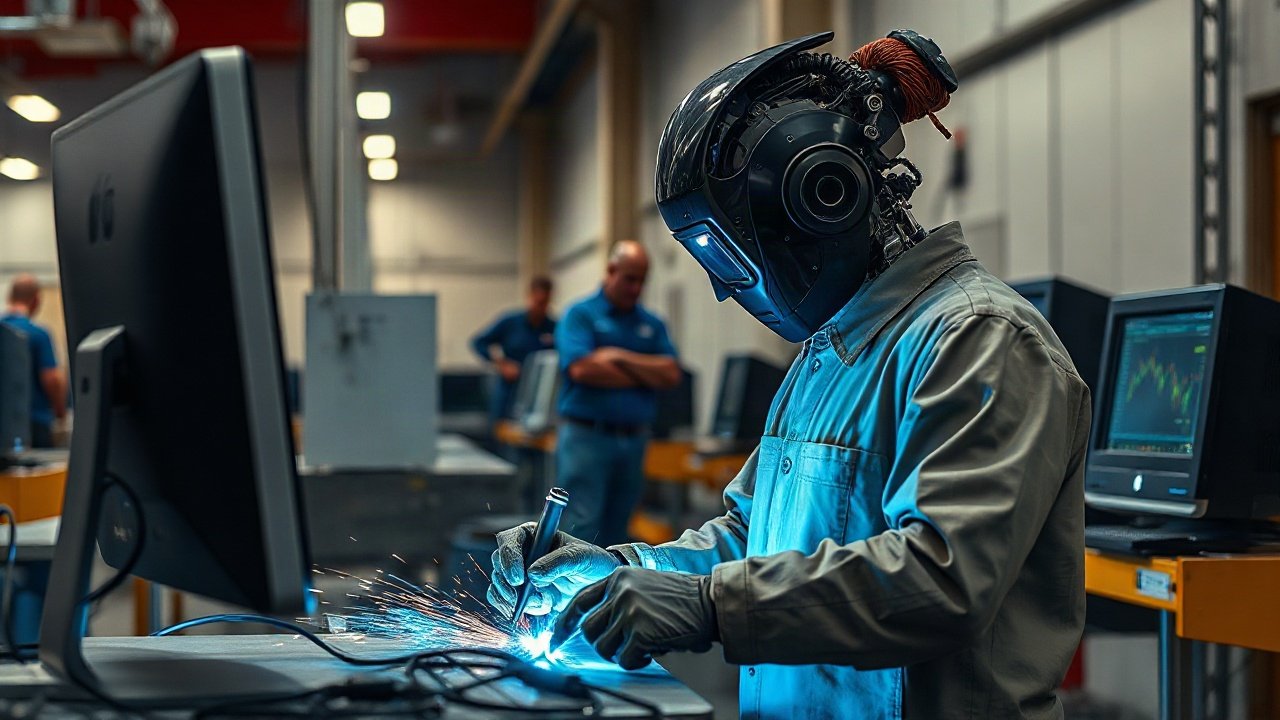
Welding has been automated for years in high-volume manufacturing. AI can make robotic systems better at vision, path planning and quality control. The employment risk is therefore more real than in many trades. The key distinction is between repetitive production welding and one-off fabrication or site work where parts, access and fit-up change constantly.
Robotic welding can replace repetitive welding hours inside controlled cells without being able to handle every repair, position, material or site condition a skilled welder encounters.
Factories are the easiest place to replace welding hours
Automotive and other manufacturing lines already use robots for repeatable welds where components arrive in the same position. The robot can follow a programmed path at high speed with consistent output and little fatigue.
AI and machine vision improve this model by helping the system adjust to small variation, detect seams and monitor quality. That can reduce the number of workers required for repetitive production welding.
Fit-up quality determines whether automation works well
A robot performs best when parts are accurately located and fixtures keep geometry consistent. Real fabrication often contains distortion, imperfect preparation or components that do not arrive exactly as designed. Skilled welders compensate continuously.
Vision systems are getting better at handling variation, but the more inconsistent the workpiece becomes, the more difficult it is to maintain reliable automated quality.
One-off fabrication has weaker economics for robotics
Programming and setting up automation costs time. If a shop produces thousands of identical assemblies, that cost is spread across many parts. If every job is different, the setup may take longer than a skilled welder needs to complete the work.
That is why custom fabrication, repair and small-batch work retain more human labour. Flexible robotics can lower the setup barrier, but economics still favour automation most strongly where repetition is high.
Site welding is a different automation challenge
Construction, maintenance and repair welding may happen outdoors, at height, in restricted spaces or around equipment that cannot be moved into a cell. The welder has to position themselves, prepare surfaces and adapt to access constraints.
A robot capable of welding in those environments needs mobility, perception and safe interaction with an uncontrolled site. That is far harder than moving a torch along a known factory path.
Inspection and quality assurance are increasingly automated
AI vision can inspect bead shape, surface defects and process data while the weld is being made. Sensors can detect deviations in current, travel speed or heat input. This can reduce manual checking and identify problems earlier.
Certified work still requires a quality system and people who understand the process. Automated inspection changes what inspectors and welders do, but it does not make material behaviour or procedure compliance irrelevant.
Welders may shift toward robot setup and difficult joints
A shop using robotic cells still needs people to prepare parts, maintain equipment, program or teach paths, solve faults and handle jobs the robot cannot do. Experienced welders often understand the process well enough to become valuable automation operators.
That creates a pathway from pure manual production into robotic welding, quality and fabrication planning. The trade changes rather than simply splitting into humans versus machines.
Certification and specialist processes create barriers
Pressure vessels, pipelines, structural work and specialist alloys can require approved procedures and qualified welders. High consequence makes process control and traceability more important, not less.
Automation can absolutely be used in these sectors, but it has to be qualified and monitored. The ability to understand why a weld is acceptable remains valuable around the machine.
The highest-risk welding jobs are the most repetitive
Workers doing the same accessible weld on identical parts face the strongest automation pressure because the business case is straightforward. Welders who work across repairs, complex positions, unusual materials and variable fabrication face a slower path to replacement.
Career resilience means moving toward the parts of welding that require setup, judgement and flexibility while learning enough automation to operate alongside robotic systems rather than competing with their strongest use case.
Continue from here
Evidence baseline
- International Labour Organization — Generative AI and jobs: 2025 update
- UK Government — AI capabilities and the UK labour market
Industrial automation already performs large volumes of repeatable welding. AI mainly expands the range and adaptability of robotic systems rather than creating automation from nothing.
Cobots lower the automation barrier for smaller workshops
Traditional industrial robots often need fixed guarding, programming and high-volume production to justify the investment. Collaborative robots and easier path-teaching systems can make automation practical for shorter runs and smaller fabricators. AI vision can reduce setup time further by locating seams and adapting to variation.
That broadens the employment risk beyond giant automotive factories. A small workshop may automate selected repetitive joints while keeping skilled welders for setup, difficult positions and rework.
Repair welding remains difficult because the starting condition is unknown
Repair work begins with wear, cracking, contamination or damage rather than a clean CAD model. The welder may have to remove material, inspect the defect and decide how much of the original structure can be trusted before choosing a repair approach.
That diagnostic and adaptive work is much harder to automate than a new production weld with known geometry. Field repair is therefore one of the more resilient parts of the trade.
Programming the robot still benefits from welding knowledge
A robotic system needs travel speed, torch angle, sequence and process parameters that reflect how the metal behaves. Software can recommend settings, but experienced welders recognise when heat input, distortion or access will create trouble.
Workers who learn robotic programming and inspection can transfer their manual process knowledge into the automated cell, turning technology change into a higher-leverage version of the same craft.
Automation can improve safety while reducing routine labour
Moving repetitive welding into robotic cells can reduce worker exposure to fumes, heat, awkward posture and arc radiation. That is a genuine benefit even when it also removes manual welding hours. The employment debate should not treat every automated task as a loss with no upside.
The strongest long-term position is to be the worker who can set up, inspect and troubleshoot the automated process while still having the manual skill to handle work outside the cell.