AI JOBS & INCOME
Will AI Replace Mechanical Engineers? Design Optimisation Is Accelerating, but Machines Still Meet the Physical World
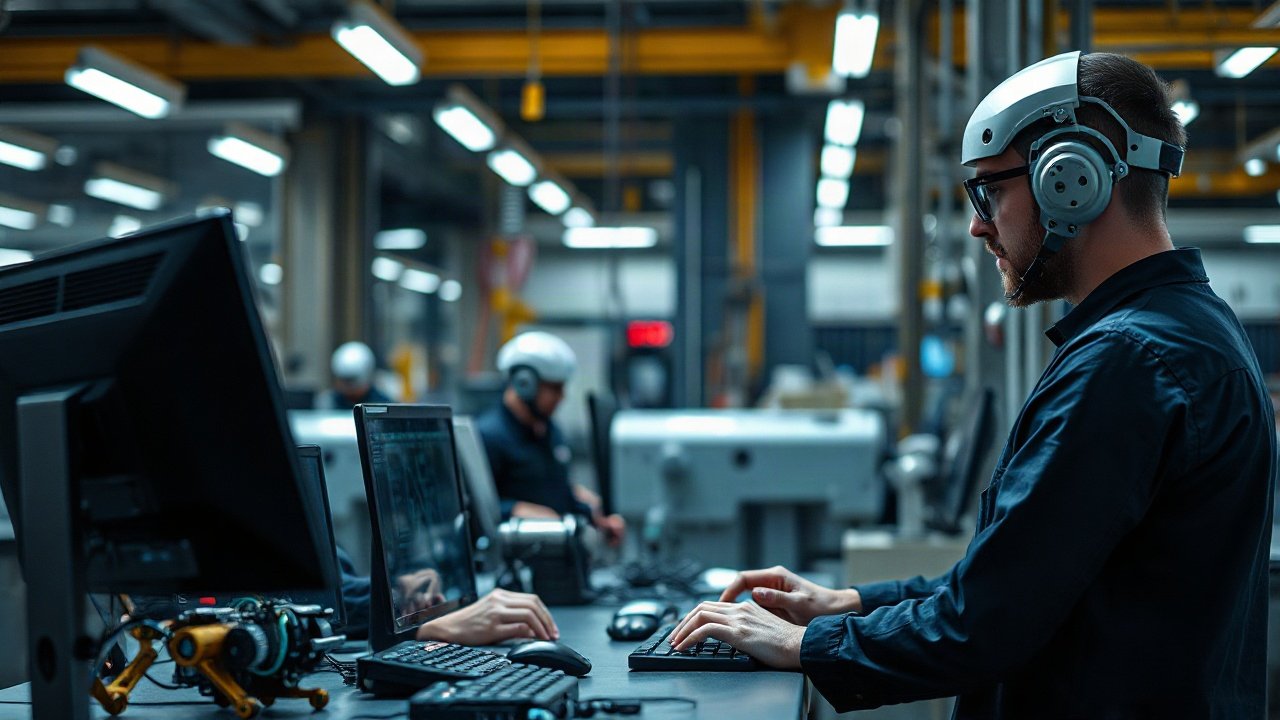
AI can generate design options, automate simulation setup, predict equipment failure and assist with technical documentation. Mechanical engineering therefore faces meaningful automation in its digital workflows. The profession also works with materials, tolerances, manufacturing, heat, vibration, wear and safety in the physical world. Engineers who use AI well may produce more with smaller teams, but physical accountability and testing remain difficult to remove.
A model can optimise geometry without owning the consequences when the component is manufactured, loaded, heated, worn and maintained in conditions that differ from the simulation.
Generative design can explore geometry at machine speed
AI-assisted tools can create large numbers of shapes against constraints for weight, stiffness, cost or material use. Engineers can discover solutions that would be impractical to sketch manually.
The result still has to be manufacturable, inspectable and maintainable. A mathematically efficient shape may be awkward to machine, impossible to assemble or too fragile in service if the constraints do not capture real production conditions.
Simulation work is becoming more automated
Models can help prepare finite-element or fluid simulations, interpret results and suggest which parameters deserve another run. This reduces repetitive setup and allows engineers to explore more scenarios.
Simulation remains sensitive to boundary conditions, mesh choices and material assumptions. Mechanical engineers need enough fundamentals to recognise when a beautiful contour plot is answering the wrong physical question.
CAD production will require fewer manual hours
AI can generate features, convert concepts into geometry and automate repetitive drawing work. Design teams may therefore produce more documentation with fewer hours of junior CAD effort.
That increases the value of engineers who understand interfaces, tolerances and how the complete assembly behaves. The job moves from drawing every feature toward defining and verifying the system.
Manufacturing constraints keep design grounded
Components interact with machining, casting, forming, welding and additive processes, each with practical limits. AI can encode many rules but real factories contain supplier-specific capability and variation.
Engineers work with production teams to decide whether a design is robust at volume, not merely possible once. That collaboration is difficult to replace with a generic optimisation engine.
Materials decisions still depend on failure modes
AI can search databases and recommend materials based on strength, weight, cost or temperature. Real selection also involves fatigue, corrosion, fracture, joining, availability and inspection.
Mechanical engineers need to understand how a component is likely to fail and what consequence that failure creates. The safest material is not always the one with the best single headline property.
Physical testing remains the reality check
Prototypes and test rigs expose vibration, noise, leakage, deformation and wear that models may miss. AI can automate data collection and identify unusual patterns across huge test datasets.
Someone still has to decide whether the anomaly is acceptable, whether the test itself is valid and what change should follow. Physical evidence can overturn a digital prediction, and engineers must know when it should.
Predictive maintenance changes engineering operations
Sensor data can help estimate bearing wear, thermal problems or developing faults before equipment fails. Maintenance can move from fixed schedules toward condition-based intervention.
Predictions do not repair machines. Engineers must decide whether to keep equipment running, isolate it, order parts or redesign the recurring failure, balancing production needs against safety and cost.
Safety-critical engineering demands accountable review
Mechanical systems in transport, energy, pressure equipment and industrial machinery can cause serious harm when they fail. Organisations therefore need traceable design decisions, checking and independent assurance.
AI can support that process but cannot become a convenient excuse for weak engineering control. The named professionals still need to understand and defend the decision.
Junior engineers may do less repetitive drafting and calculation
Traditional early-career work includes drawings, calculations, test reports and revisions. AI can accelerate much of that production, changing how new engineers build experience.
Employers need deliberate training so graduates still learn fundamentals and failure modes. The person supervising automated output must be capable of recognising an error that looks completely plausible.
The resilient mechanical engineer combines physics with AI leverage
Engineers who understand mechanics, thermodynamics, materials and manufacturing can use AI to explore more designs and diagnose problems faster.
Automation may reduce headcount for routine digital production, but the physical world preserves a strong need for verification, testing and accountable judgement. AI changes the workflow more readily than it removes mechanical engineering itself.
Continue from here
Evidence baseline
- International Labour Organization — Generative AI and jobs: 2025 update
- UK Government — AI capabilities and the UK labour market
- IMechE — Engineering the Future With AI
- IMechE — AI for engineers
The Institution of Mechanical Engineers now provides dedicated AI training and resources for engineers, presenting AI as a major productivity and problem-solving capability that must be integrated with engineering expertise.
Supplier engineering keeps designs connected to what can actually be bought
Mechanical systems depend on bearings, seals, fasteners, motors, castings and many other components with real lead times and supplier variation. AI can search catalogues and identify nominal alternatives, but substitutions often change interfaces, lifetime, lubrication, certification or maintenance requirements.
Engineers need to review those consequences across the complete assembly. A seemingly small component change can create vibration, heat or reliability problems elsewhere, which makes supplier decisions a systems-engineering task rather than a simple lookup.
Failure investigation depends on evidence from damaged hardware
When a machine breaks, the most useful clues may be fracture surfaces, wear patterns, loosened joints, contamination or a sequence of operator observations. AI can compare symptoms with known failure modes, but the evidence may be incomplete and altered by the failure itself.
Mechanical engineers combine inspection, test data and operating history to reconstruct what happened. That forensic role is difficult to automate because every serious failure contains some mixture of design, manufacture, maintenance and use.
Maintenance access has to be designed before failure
A machine may meet performance targets yet be expensive or dangerous to service because filters, bearings or fasteners cannot be reached easily. Mechanical engineers consider access, lifting, isolation and replacement procedures before the equipment is built. AI can flag known rules, but maintainability depends on understanding how people will actually work around the finished machine.