AI JOBS & INCOME
Will AI Replace Firefighters? Prediction and Command Support Can Improve, but Emergency Response Is Physical
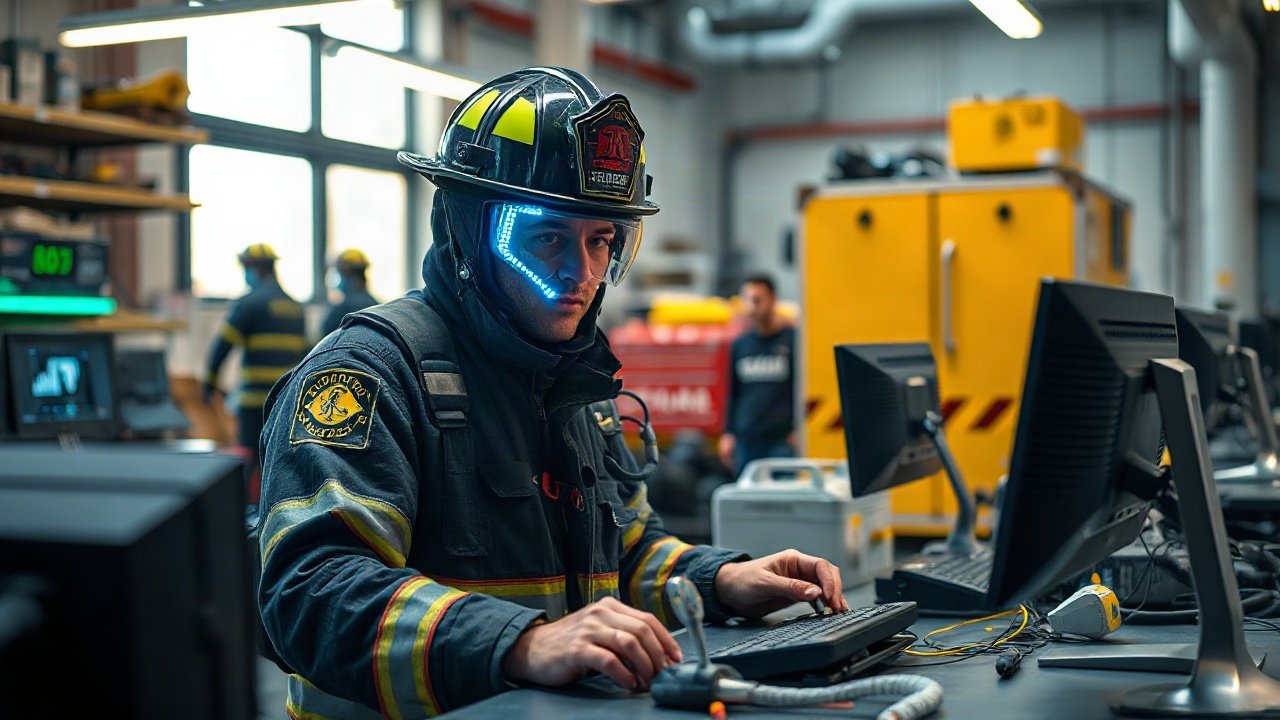
Fire and rescue services are exploring AI for predictive analytics, reporting and resource optimisation, while digital platforms already support operational data across Great Britain. Frontline firefighting remains an extreme physical job involving rescue, hazardous environments and rapidly changing incidents. AI is more likely to improve information, prevention and command support than remove the crews who enter unsafe spaces and act when systems cannot see the whole scene.
A model can predict risk or recommend resources without physically rescuing a trapped person, forcing entry, handling a hose or accepting responsibility when an incident changes faster than the data.
Risk prediction can improve prevention
AI can analyse incident history, building information and environmental conditions to help services identify areas or properties where prevention work may be most useful.
Prediction can prioritise attention but does not prove that a particular incident will occur. Fire services still need professional judgement about inspections, community engagement and how to use limited prevention resources fairly.
Dispatch and resource optimisation can become smarter
Systems can combine location, appliance availability and incident information to support mobilisation decisions. Buckinghamshire's 2026 plan explicitly identifies resource optimisation as a potential AI use case.
Control rooms still face incomplete calls, multiple incidents and changing information. Human operators and commanders need to interpret uncertainty and escalate resources when the initial classification underestimates the event.
Drones and robots can reduce exposure to danger
Uncrewed systems can inspect roofs, hazardous sites or large outdoor incidents without immediately sending a firefighter into the same position. Thermal cameras can reveal information that is difficult to see from the ground.
These tools extend situational awareness rather than remove crews. Someone still needs to interpret the feed and carry out rescue, firefighting or containment where a machine cannot operate effectively.
Search and rescue is physically and ethically difficult to automate
Rescuing people from smoke, collapsed structures, vehicles or water requires movement through unpredictable spaces and decisions about immediate risk.
Robotics may eventually handle more dangerous tasks, but broad autonomous capability in chaotic emergency environments is far harder than warehouse automation. Human firefighters remain the flexible response system.
Incident command relies on information that can be incomplete or wrong
Commanders combine building layout, fire behaviour, crew reports, weather and changing hazards while maintaining crew safety. AI can fuse data and present options.
The commander still owns the operational decision when communications fail or the scene behaves differently from the digital picture. National work following Grenfell continues to emphasise communication and incident-command learning.
Communications failure is itself part of the risk
Firefighters work in environments where radio signals can be unreliable. Guidance specifically recognises the need to train for loss of communications rather than assuming connectivity is always available.
That limits dependence on cloud or AI systems during the most dangerous phase of an incident. Crews need procedures and judgement that still work when technology degrades.
Physical fitness and manual skill remain core
Hose management, ladders, breathing apparatus, forced entry and casualty movement involve strength, coordination and team practice. These skills cannot be replaced by a software recommendation.
Automation may reduce some exposure and improve equipment, but frontline emergency response remains tied to people and machines capable of operating physically in difficult environments.
Post-incident reporting is much more automatable
AI can summarise logs, radio traffic and incident records, reducing administrative work after an emergency. Data platforms also make consistent national reporting easier.
That can return time to training and prevention. It is a productivity gain around the firefighter role rather than direct substitution for the role's most important task.
Wildfire and climate risks may increase demand for capability
England recorded a substantial increase in fires in the year ending March 2026, including a sharp rise in outdoor fires. Future incident patterns may create new operational demands even as technology improves.
Employment therefore depends on risk and service policy as well as automation. Better prediction can help allocate crews without eliminating the need for capacity when multiple physical incidents occur.
The resilient firefighter works with better intelligence
AI can improve prevention, dispatch, mapping and command support while robots take on some dangerous inspection tasks. Those changes can make crews safer and more effective.
Frontline replacement is limited by the physical, unpredictable and accountable nature of emergency response. Technology changes how firefighters reach and understand an incident more readily than it removes the need for people at the scene.
Continue from here
Evidence baseline
- International Labour Organization — Generative AI and jobs: 2025 update
- UK Government — AI capabilities and the UK labour market
- Buckinghamshire Fire & Rescue Service — Annual Delivery Plan 2026–27
- MHCLG Digital — Fire and Rescue Data Platform
- GOV.UK — Fire and rescue incident statistics, year ending March 2026
UK fire services in 2026 are exploring AI integration for analytics and resource optimisation, while national fire policy continues to emphasise communication, incident command, training and operational readiness for real emergencies.
Medical and road-traffic incidents broaden the role beyond fire
Fire and rescue services attend many incident types where the hazard is not simply flame. Road collisions, flooding, rescues and assistance to other emergency services require adaptable crews and physical tools.
A narrow fire-prediction system therefore addresses only part of the occupation. The workforce exists because communities need a flexible emergency capability that can respond when the exact problem is not known in advance.
Team coordination is itself a safety control
Firefighters work in crews with defined roles, checks and communication practices because individuals can lose situational awareness in heat, smoke and stress. Team members watch each other as well as the incident.
AI can add information, but it does not replace mutual physical support or the confidence that another trained person will intervene when conditions deteriorate.
Community prevention remains relational
Home safety visits, school work and engagement with vulnerable residents depend on communication as much as risk data. A model may identify a high-risk household without knowing how to persuade the person to change behaviour.
Firefighters and prevention staff can build trust and adapt advice to the situation. That human contact is part of reducing incidents before an appliance is ever mobilised.
Training must prepare crews for technology failure
Better digital tools can create dependency if crews stop practising judgement without them. Emergency services need drills for degraded communications, incomplete maps and equipment failure because the worst incident may also disrupt normal infrastructure.
That makes experienced human capability a resilience layer. AI can strengthen the service while the service still has to function when AI is unavailable.